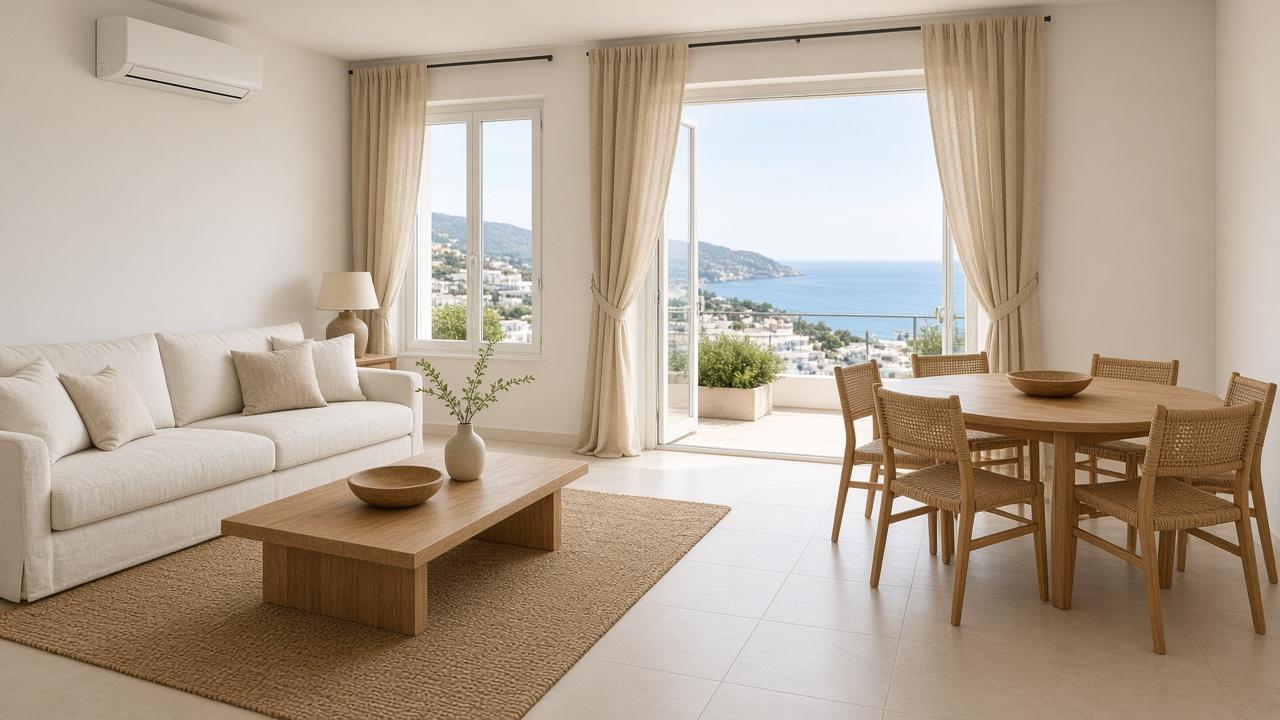
Andalusia Holiday Rental Licence (VFT): What Your Apartment Must Have
What Andalusia's VFT/VUT holiday rental rules require inside your apartment, from bed sizes and air conditioning to the kitchen kit, with official sources.
If you are furnishing an apartment for holiday lets in Andalusia, the Junta de Andalucía publishes a surprisingly specific list of what it must contain, down to bed sizes and the kitchen scissors. Here it is in plain English, mapped to the furniture and kit that meet it.
What does an apartment need to be a legal holiday rental in Andalusia?
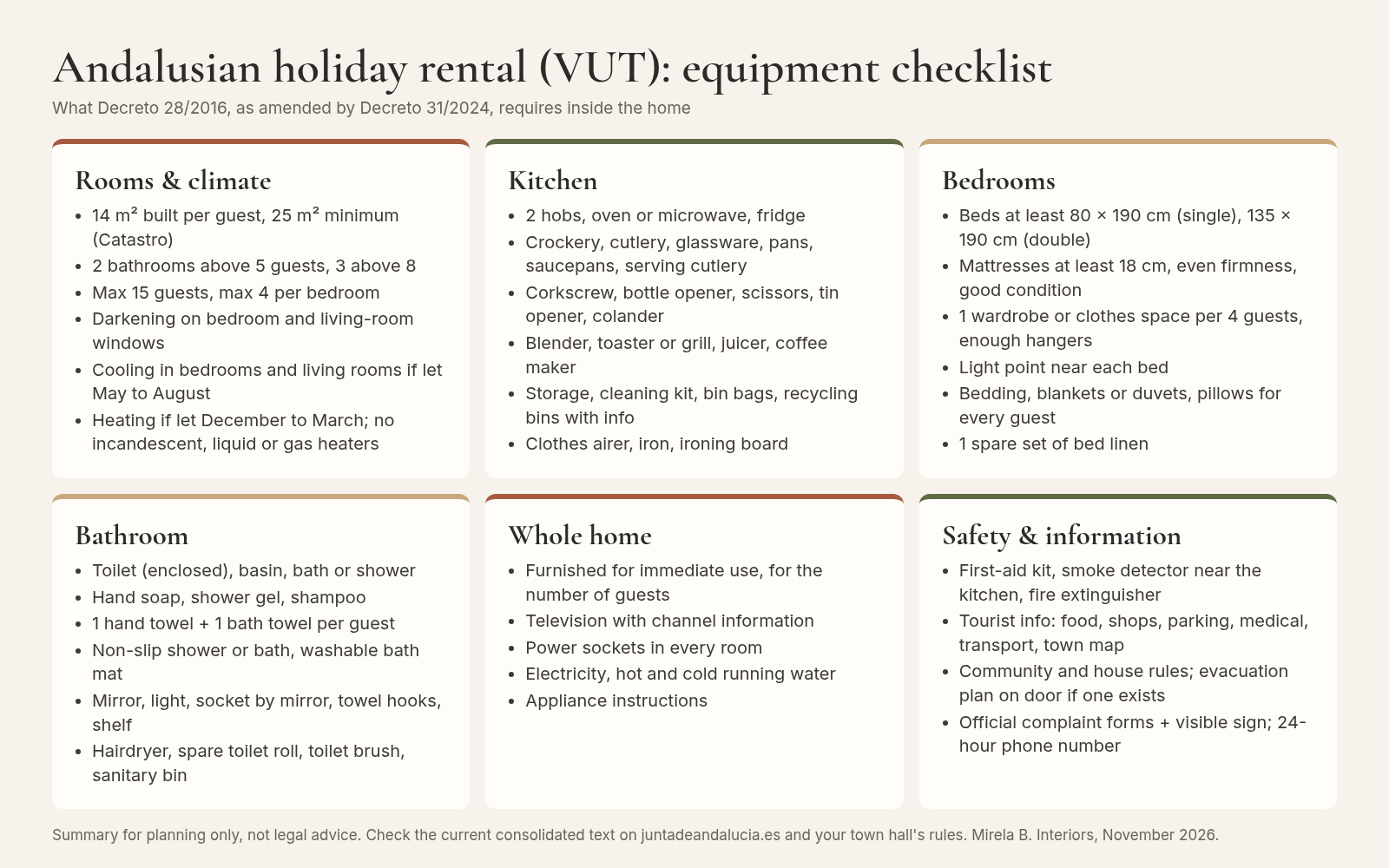
It must be registered with the Registro de Turismo de Andalucía and meet Decreto 28/2016 as amended in 2024: at least 14 m² per guest, blackout on bedroom and living-room windows, cooling or heating for the months you let, and a fully furnished, equipped home, from bed sizes and kitchen kit to a first-aid kit, smoke detector and extinguisher.
Below I go through each requirement and what it means for furniture and equipment.
Please read this first. I am an interior designer, not a lawyer or a gestor. Everything below comes from the official texts published by the Junta de Andalucía and the Spanish authorities, checked on 19 November 2026, and I have linked each source so you can read it yourself. Rules change, town halls add their own, and your building may have its own restrictions. Treat this as a practical guide, not legal advice, and confirm the current position with the Junta, your town hall and a qualified adviser before you commit money.
VFT or VUT: what the licence is actually called
Many owners and agents still say "VFT licence". That comes from the original name in Decreto 28/2016, viviendas con fines turísticos. Since the 2024 reform the official term is vivienda de uso turístico, or VUT, and the registration codes now look like VUT/MA/00000, where MA stands for Málaga province. Same idea, new name. If you search the Junta's website, search for VUT.
Strictly speaking it is not a licence you wait for. You submit a declaración responsable, a sworn statement that the home already meets the rules, and the Junta registers the property in the Registro de Turismo de Andalucía. Inspectors can check.
The rules sit in three texts:
- Decreto 28/2016, published in BOJA on 11 February 2016, which created the regime.
- Decreto 31/2024, published in BOJA on 2 February 2024 and in force from 22 February 2024, which rewrote the requirements, added the minimum size per guest, the bathroom rule and the climate rule, and replaced the equipment annex.
- Decreto-ley 1/2025, which added a reference to the planning licence or declaration that allows tourist use, where the urban planning rules require one.
The Junta publishes a consolidated version of Decreto 28/2016 with all of these changes folded in. That PDF is the one I keep open when I plan a rental, and it is the source for every requirement below unless I say otherwise. Homes that were already registered before 22 February 2024 were given one year to adapt to the new climate and equipment rules, so that window has now closed for everyone.
Before the furniture: the property itself
None of the furnishing work matters if the property cannot be registered in the first place. These are the points I ask owners to check before we talk about sofas.
Planning, building rules and exclusions
The home must comply with the town hall's planning rules. When the Junta registers a property, it tells the town hall straight away, and if the town hall says the use does not fit its planning, the registration can be cancelled.
Some homes cannot be holiday rentals at all: officially protected housing (VPO), homes in buildings whose deeds or community statutes expressly prohibit tourist accommodation, and homes in the "asimilado a fuera de ordenación" situation unless the town hall has expressly authorised the change. My article on Spanish permits for foreign owners covers the renovation side of planning if you are also doing works.
Size and capacity
The size and bathroom rules were added in 2024, and they decide how many beds you should buy.
- 14 m² per guest. The home needs at least 14 m² of built area per plaza (guest place), measured on the main-use built area shown in the Catastro. The minimum for any home is 25 m², or whatever the local planning sets.
- Bathrooms. More than five guests needs two bathrooms; more than eight needs three.
- Caps. A whole home can take a maximum of fifteen guests. No bedroom can take more than four, and at least two of those four must be in beds that are not bunks.
- Sofa beds. Up to two convertible places are allowed in the living room of a whole home, and they count towards the maximum.
A quick worked example: a two-bedroom apartment with 84 m² built in the Catastro allows up to six guests on the size rule, but with only one bathroom it is capped at five. That means four places in the two bedrooms and one sofa-bed place at most. I would rather know that before I specify a sofa bed than after.
Windows, ventilation and blackout
Bedrooms and living rooms need direct ventilation to the outside or to a ventilated patio, and "some system of darkening the windows". Kitchens and bathrooms need direct or forced ventilation. The darkening rule can be waived only where the authorities exempt a building for architectural protection reasons.
In practice most Costa del Sol apartments have persianas (roller shutters) in the bedrooms, which do the job. Living rooms with big sliding doors to the terrace are where the gaps tend to be. Sheer linen looks lovely in photos and darkens nothing. My answer is usually a pair of lined curtains or a blackout roller blind behind something softer. Curtains are not part of my standard packages because every window is a different size; I measure and quote them separately, and for a rental I always include them in the conversation early.
Cooling and heating
This requirement is tied to the months you let:
- If your declared operating period includes May, June, July or August, bedrooms and living rooms need cooling, centralised or not, fixed or portable.
- If it includes December, January, February or March, they need heating, again fixed or portable.
- Incandescent heaters and heaters that burn flammable liquids or gas are not allowed in any case.
You declare your operating periods when you register, and you can only market the home in those periods. If you let all year, you need both. Ducted air conditioning with a heat pump covers both in one system, and many recent new builds have it. Older apartments often have a split unit in the living room and nothing in the bedrooms, which the rules no longer allow for summer lets.
Furniture and equipment: what the annex requires, room by room
The annex to the decree is where furnishing comes in. Its opening line is broad: the home must be "sufficiently furnished and equipped with the appliances and items needed for immediate use, in line with the number of guest places". After that it gets very specific. Here is how I translate it into a shopping and planning list.
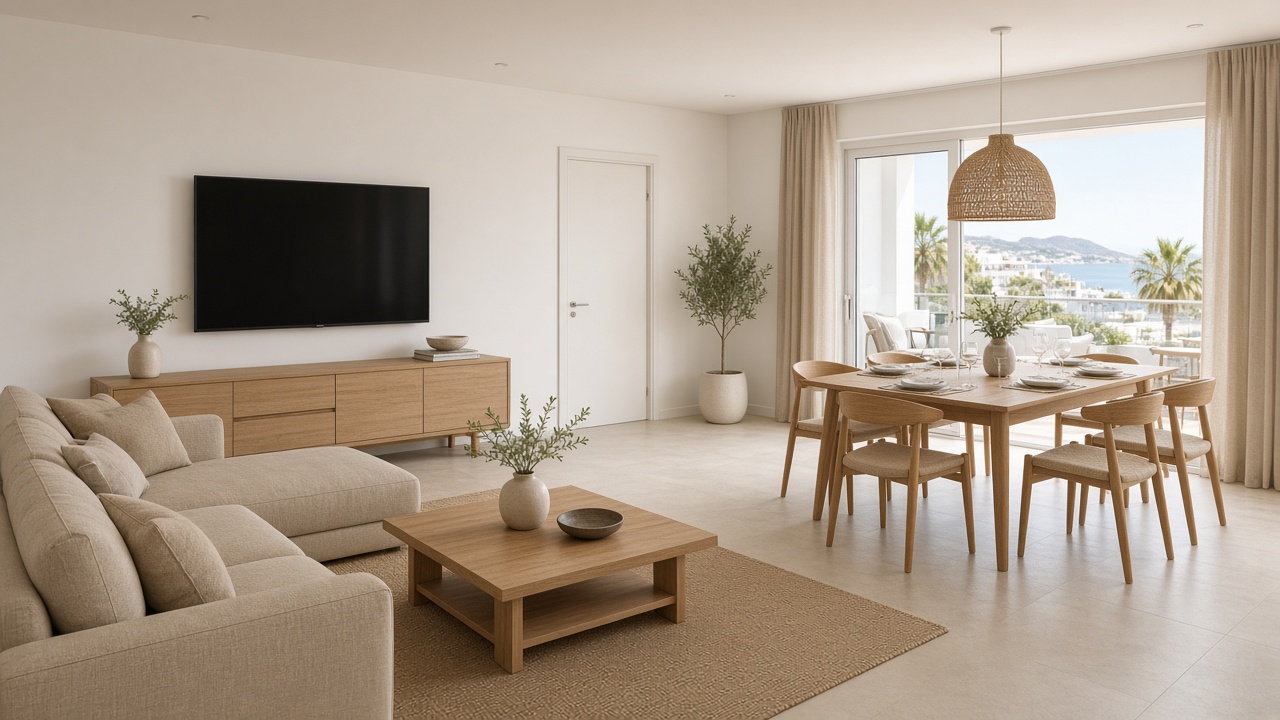
Whole home and living room
- A television, with information on the channels available.
- Power sockets in every room.
- Basic supplies that make the home habitable: electricity and hot and cold running water.
- Enough furniture for the number of guests.
The rules do not say "a sofa for six", but "sufficiently furnished in line with the number of places" is the test. My own rule of thumb, not the Junta's, is a seat in the living room and a chair at the dining table for every registered guest. A rental for five with a four-seat dining table looks underfurnished in the listing.
Kitchen
The kitchen list is the longest. The annex asks for:
- At least two hobs, an oven or microwave, and a fridge.
- Utensils for the number of guests: at least crockery, cutlery, glassware, frying pans, saucepans, serving cutlery, a corkscrew, a bottle opener, scissors, a tin opener and a colander.
- Small appliances: at least a blender, a toaster or grill, a juicer and a coffee maker.
- Storage furniture.
- Cleaning utensils and a cleaning kit, with at least a scourer, two cloths (a bayeta and a paño) and cleaning gel, plus bin bags.
- A clothes airer, an iron and an ironing board.
- Separate waste bins for recycling, with information on how to use them.
I count crockery and glassware per guest and add a margin, because something always breaks: for five guests, at least eight of each everyday item. The juicer surprises people, but it is on the list.
Bathrooms
Each bathroom needs at least a toilet, a basin, and a bath or shower tray, and the annex lists the rest:
- Hand soap, shower gel and shampoo.
- One hand towel and one bath towel per guest.
- Non-slip surfaces in showers and baths, and a washable bath mat.
- Suitable lighting, a mirror, towel hooks or rails, and a socket next to the mirror.
- A spare toilet roll, a toilet brush, a shelf, a hairdryer and a sanitary bin.
The toilet must also be enclosed, either in its own room or in a closed bathroom with the other fittings. Non-slip is easy to overlook in new builds with smooth porcelain shower trays. Adhesive anti-slip strips or a fitted mat solve it for very little money.
Bedrooms and bedding
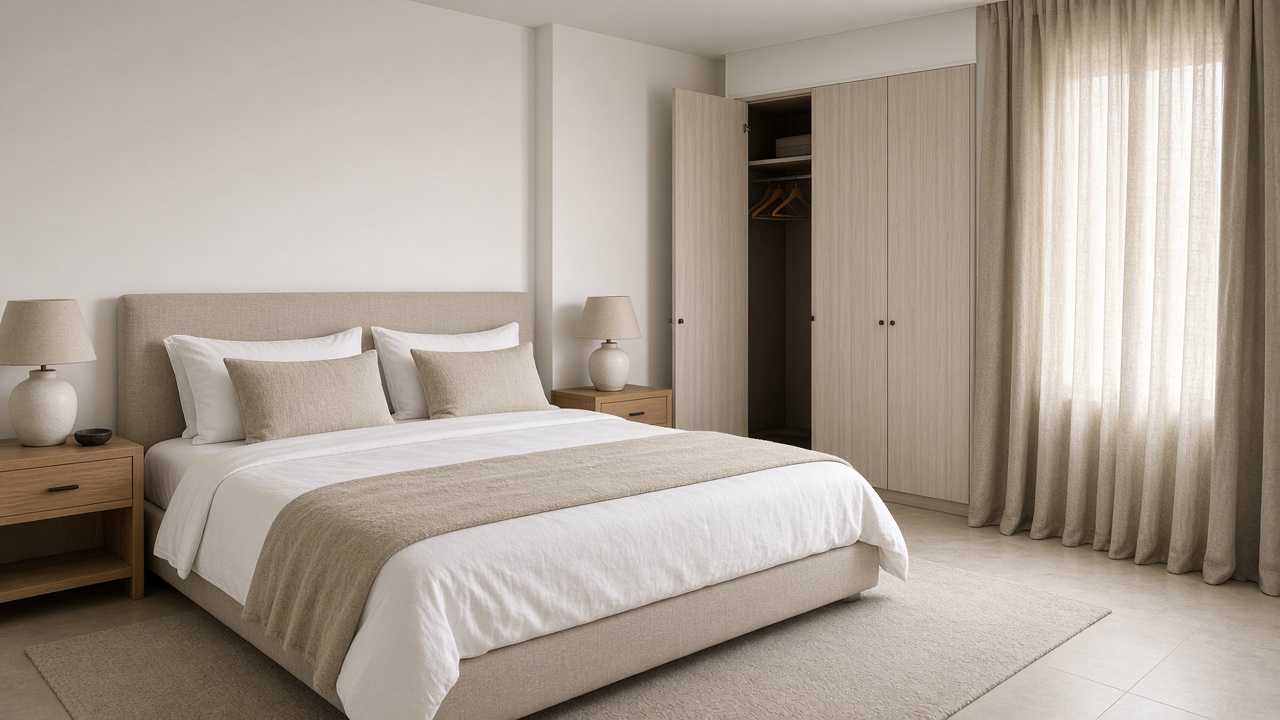
This is where the rules directly shape the furniture I specify:
- Beds of at least 80 x 190 cm for a single and 135 x 190 cm for a double.
- Mattresses at least 18 cm thick, and both bases and mattresses in good condition with even firmness across the whole surface.
- One wardrobe or clothes storage space for every four guests, with enough hangers. It can be in any bedroom.
- A light point near each bed.
- Bedding, linen, blankets or duvets and pillows in good condition for the number of guests, plus one spare set of bed linen.
The legal minimum for a double is 135 cm wide, which is a common Spanish size. For a rental aimed at couples from northern Europe, I prefer 150 x 190 cm or 150 x 200 cm if the room allows at least 60 to 70 cm of clearance on both sides. On mattresses, 18 cm is a floor, not a target. A good rental mattress is usually deeper than that, and the "even firmness" wording is a reason to replace a sagging mattress rather than hide it under a topper.
Safety
- A first-aid kit.
- Some type of smoke detector in the area near the kitchen.
- A fire extinguisher.
A fire extinguisher behind the bin bags under the sink is not much use. I like a small bracket by the kitchen door or in the entrance cupboard, and the first-aid kit on a labelled bathroom shelf.
Information for guests
The annex and Article 6 of the decree also require information, which I treat as part of the styling because guests read it more when it looks cared for:
- Tourist information on the area, in print or digital: leisure, restaurants and cafés, shops and food stores, the nearest parking, medical services, local transport and a town map.
- Instructions for appliances and other devices that need them.
- The community rules, restricted areas, rules for using the home and its equipment, whether pets are allowed, smoking restrictions, where to leave rubbish and local noise rules.
- An evacuation plan on the door of the home, if the building has one.
- The Junta's official complaint forms (hojas de quejas y reclamaciones), with the sign announcing them displayed in a visible place inside the home.
The operator must also provide a 24-hour phone number, clean at every check-in and check-out, and give guests a document showing the registration code, number of guests, dates and total price. If you use a property manager, ask them to confirm in writing that they cover these.
How I furnish a rental-ready apartment around these rules
The list is the easy part. What makes a rental work is the layer above it: furniture sized to the registered guests, materials that cope with a turnover every few days, and rooms that photograph well enough to get booked.
When I plan an apartment for holiday lets, I start from the registrable capacity, because that one number drives the beds, the sofa, the dining table, the towels and the crockery. Then I plan the bedrooms, check every window and room against the darkening and climate rules, lay out the living room for the registered guests, and finish with the annex kit and the safety items.
My furniture packages cover a large part of this. They include the design and selection of furniture, lighting, rugs and decor for the living room, dining area and bedrooms, outdoor furniture for the terrace, delivery, assembly, installation and final styling. The Essentials package, from €16,500 + IVA for two bedrooms, is the one I designed with holiday rentals and investors in mind: durable, easy to maintain and good in photos. You can see both tiers on the package pricing page.
To be clear about what the packages do not list: curtains are measured and quoted separately, and the kitchen kit, bathroom consumables, bedding, towels, appliances, safety items and air conditioning are not part of the published inclusions. When an owner is preparing for registration, I go through the annex with them and flag what is covered, what needs adding, and who is buying what, so nothing is missed on the day of the inspection photos.
Style matters more for rentals than people expect. Of the three styles I offer, Coastal Elegance is often the natural fit for a beachside rental: light, fresh and relaxed, without shells or anchors. For a broader view of guest-friendly design, I have written separately about designing a short-term rental that earns good reviews, and if you are budgeting the whole setup, what it costs to furnish an apartment on the Costa del Sol breaks down the numbers.
Registering the property: the steps in order
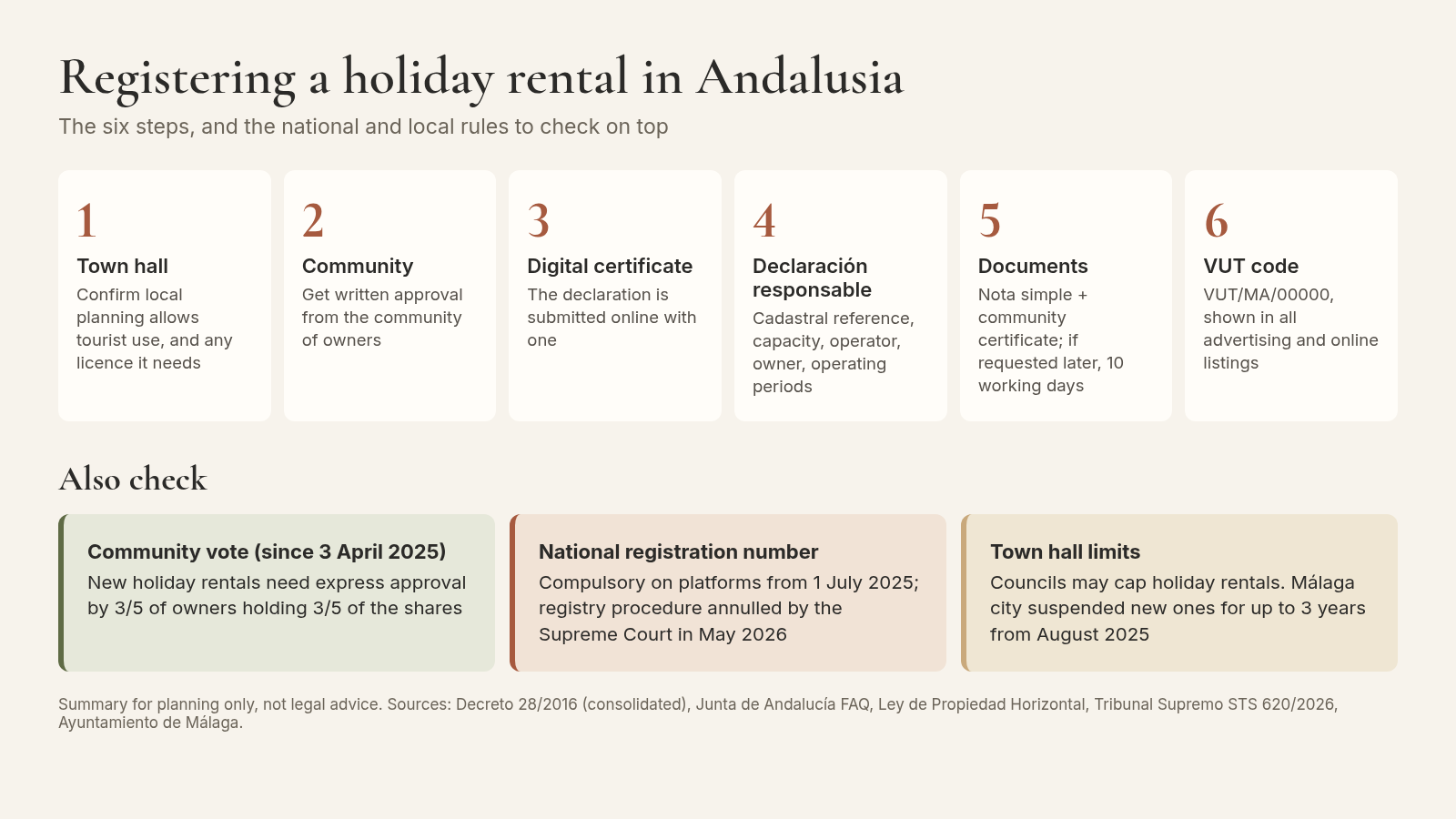
Registration is done online through the Junta's holiday rental page, and the Junta's own FAQ on holiday rentals is clear and worth reading. In outline:
- Check with your town hall that the home complies with local planning for tourist use, and whether you need a planning licence or declaration for that use.
- Get the community's written approval if the home is in a building with a community of owners (more on that below).
- Get a digital certificate. The Junta's FAQ says the declaration must be submitted electronically with one.
- Submit the declaración responsable stating the property's details, cadastral reference, maximum capacity, the operator and owner, and the operating periods.
- Attach the supporting documents. The Junta asks for an up-to-date nota simple from the Land Registry and a certificate from the community secretary or administrator confirming the community's express approval, plus other documents in specific cases. If you do not attach them, you will be asked for them later and given ten working days.
- Receive your registration code, in the format VUT/MA/00000 for Málaga province. According to the Junta, that code must appear in all advertising, including online platforms.
The Junta states that registration itself costs nothing. It also runs a helpline for holiday-rental questions, 900 10 15 70, open Monday to Friday from 9:00 to 14:00. Renting through tourist channels without having submitted the declaration counts as clandestine activity, which the decree classifies as a serious infringement under the Andalusian Tourism Law.
National and local rules on top of the Junta's
The Junta's decree is the core, but it is not the only layer.
Community of owners approval
Since 3 April 2025, Spain's Horizontal Property Law requires an owner who wants to start a holiday rental in a building with a community of owners to obtain the community's express prior approval. The vote needs three-fifths of all owners, who must also hold three-fifths of the participation shares, and the same majority can limit, condition or prohibit the activity. These agreements are not retroactive. The Ministry of Consumer Affairs explains it in its FAQ on community approval. The decree itself also excludes homes in buildings whose statutes expressly prohibit tourist use.
The national registration number
From 1 July 2025, a national registration number for short-term rentals, issued through the Land Registry under Real Decreto 1312/2024, became compulsory for listing on online platforms. In May 2026, the Supreme Court annulled the parts of that decree that created the single national registry and the obligation to register for the number, while upholding the digital one-stop shop and the platforms' data-sharing duties. The court's press release on judgment 620/2026 sets out the reasoning. What platforms ask hosts for now may still be settling, so check with your adviser and your platform rather than relying on an old checklist. The judgment concerns the national registry; registering with the Registro de Turismo de Andalucía is still required.
Town hall restrictions
The decree allows town halls to set proportionate limits on the number of holiday rentals per building, area or period. Málaga city has used this: in August 2025 it started a change to its general plan and suspended new holiday rentals for up to three years. In February 2025 Marbella announced a municipal register of holiday rentals and a new ordinance to limit converting commercial premises to this use; I have not been able to confirm whether either is now in force, so ask the town hall. Mijas, Estepona, Benahavís and Casares each have their own planning, which is why step one above is the town hall and not the furniture.
The gaps that are easiest to miss
These are the items that are easiest to overlook when everything else looks finished:
- Cooling in the bedrooms, not only the living room, for summer lets.
- Darkening in the living room where there are large glass doors and only sheer curtains.
- A spare set of bed linen for every bed, kept in the home.
- The juicer, the colander and the kitchen scissors. Small, cheap, and on the list.
- Non-slip surfaces in smooth showers and baths.
- A socket beside the bathroom mirror and a light point near every bed, both of which need an electrician rather than a shopping trip.
- The complaint forms sign, displayed somewhere visible.
Catch the electrical items early, because they mean a visit from your electrician before the furniture goes in. In my packages I prepare the lighting layout so the electrician knows exactly where each point goes, which is described step by step on how the package process works.
Frequently asked questions
Do I need air conditioning to register a holiday rental in Andalusia?
Only for the months you let. If your declared operating period includes May, June, July or August, bedrooms and living rooms need cooling, fixed or portable. If it includes December, January, February or March, they need heating. Incandescent heaters and heaters burning flammable liquids or gas are not allowed, and year-round rentals need both.
What size do beds have to be in an Andalusian holiday rental?
The annex sets minimums of 80 x 190 cm for a single bed and 135 x 190 cm for a double. Mattresses must be at least 18 cm thick, and bases and mattresses must be in good condition with even firmness across the whole surface. For doubles in a rental, I usually prefer 150 cm wide where the room allows.
How many guests can I register for my apartment in Andalusia?
It depends on size and bathrooms. You need 14 m² of built area per guest, as shown in the Catastro, with 25 m² as the minimum for any home. More than five guests needs a second bathroom, and more than eight a third. A whole home is capped at fifteen guests, with no more than four per bedroom.
Does my community of owners have to approve a holiday rental?
For a new holiday rental in a building with a community of owners, yes. Since 3 April 2025, the Horizontal Property Law requires express approval, voted by three-fifths of owners holding three-fifths of the shares. The Junta also asks for a certificate from the community secretary or administrator confirming that approval when you register.
Does a holiday rental in Andalusia need a smoke detector and a fire extinguisher?
Yes. The annex to Decreto 28/2016 requires a first-aid kit, some type of smoke detector in the area near the kitchen and a fire extinguisher. None of them takes up much space, but I plan where they go at the design stage so guests can find them quickly and they do not disappear into a cupboard.
Preparing an apartment for holiday guests?
If you are getting a Costa del Sol apartment ready for registration and want the furniture, layout and equipment planned around the rules from the start, send me your floor plan, the Catastro area and the months you plan to let. I will tell you which package fits, what sits outside it, and what it will cost. You can book a call with me here, read more about my design consultation, or message me on WhatsApp at +34 664 276 642. I also keep a list of questions owners ask about the packages if you want to read those first.