Shipping Your Furniture to Spain vs. Buying New
My guide to deciding which furniture to ship to Spain and what to buy here, from scale and climate to 230-volt power, bed sizes and customs relief.
When I moved from the United States to Spain, I had to decide what came with me and what stayed behind, and many owners face the same choice before their own move to the Costa del Sol. This is how I help owners decide what is worth shipping, what is better bought here, and where the customs rules come in.
Should you ship your furniture to Spain or buy new?
For most moves, ship the pieces that are hard to replace, such as art, rugs, heirlooms and anything with a story, and buy the large, everyday furniture new in Spain. Bulky sofas, beds and appliances rarely suit Spanish rooms, mattress sizes or the 230-volt supply, and their shipping cost is easy to underestimate.
That is my rule of thumb, not a law. A family moving into a large villa in Benahavís with a good dining table and the room to use it may be glad they shipped it. A deep sectional and a king bed heading for a two-bedroom apartment in Estepona are a different story.
The decision is less about money than people expect, although money matters. It is about fit: whether each piece fits the rooms, the climate, the electrical system and the way you plan to live here. When I walk through a move with a client, we go room by room and piece by piece, and in my experience the list of things worth shipping ends up shorter than the first draft.

What shipping really costs
I am not going to quote freight prices here, because they change with the route, the season and the size of the shipment. Ask two or three international movers for written quotes based on a proper survey of your belongings. What I can do is point out the costs people tend to forget.
A household shipment is rarely one bill. Depending on the mover and the route, the total can include:
- Packing and crating at origin, including custom crates for art, mirrors and glass tops.
- Export handling, transport to the port and the ocean freight itself.
- Transit insurance, usually priced as a percentage of the value you declare.
- Customs clearance in Spain, normally handled by a customs agent or the mover's local partner.
- Port and terminal charges at arrival, and storage if your apartment is not ready when the container lands.
- Delivery to the property, which on this coast often means a narrow street, a small lift, or a building where large pieces have to come up by external hoist.
- Unpacking, reassembly and removal of packing materials.
Then there is the cost nobody puts on an invoice: weeks or months without the furniture. A sea shipment from the United States takes time, and if your shipment arrives after you do, you will be living with an air mattress, renting a furnished place, or buying temporary pieces you do not want.
The fair comparison is the full door-to-door cost of shipping, plus the inconvenience, measured against the cost of replacing only the pieces that would actually work here. When you remove the sofa that will not fit, the bed that will not take a Spanish mattress and the appliances that will not run on the local supply, the shipment often shrinks enough to change the economics entirely.
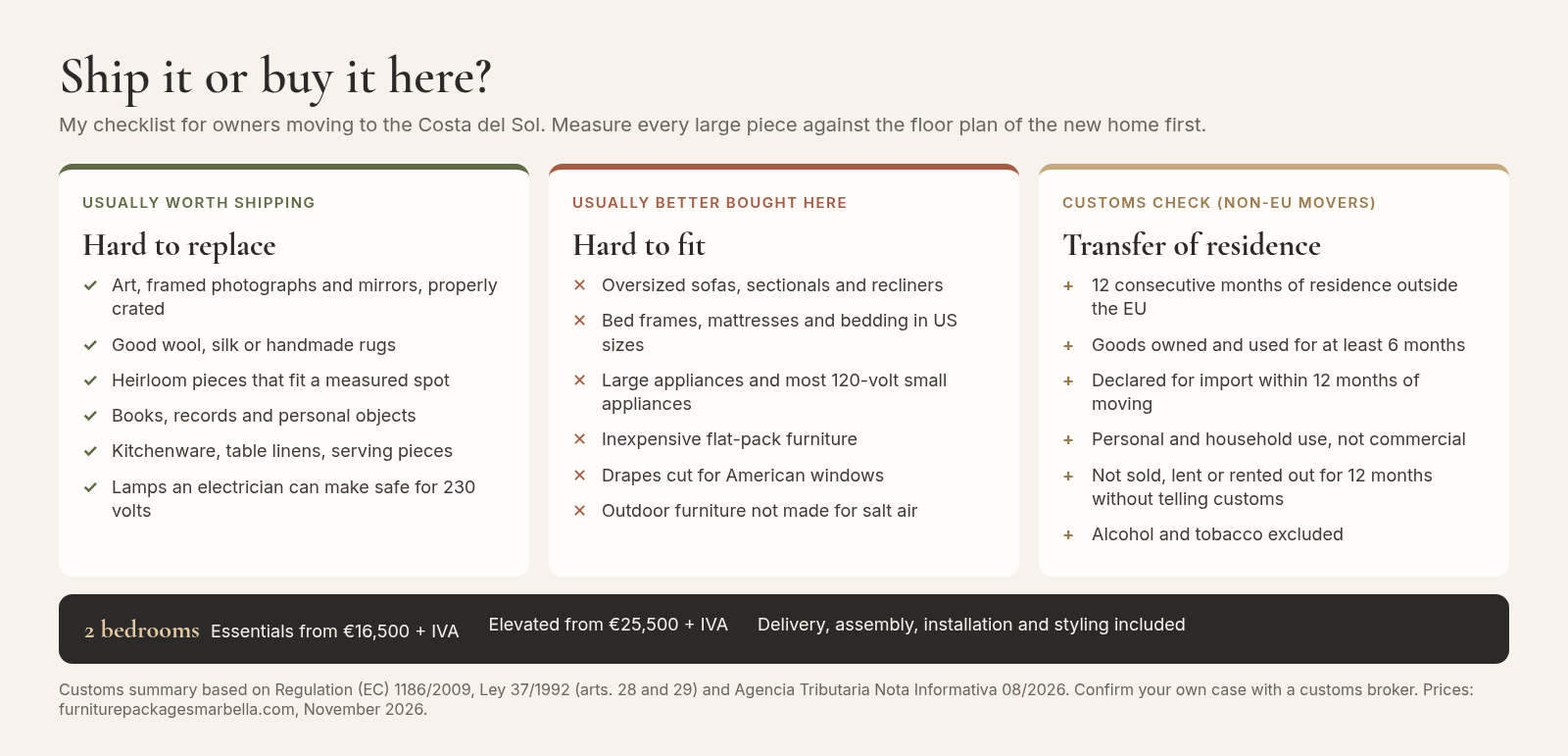
For comparison, my furniture packages start at €16,500 + IVA for a two-bedroom home in the Essentials package and €25,500 + IVA in the Elevated package, with delivery, assembly, installation and styling included. You can see every tier on the package price list. It gives you a real local number to set against your moving quotes.
Scale: why American furniture often looks wrong here
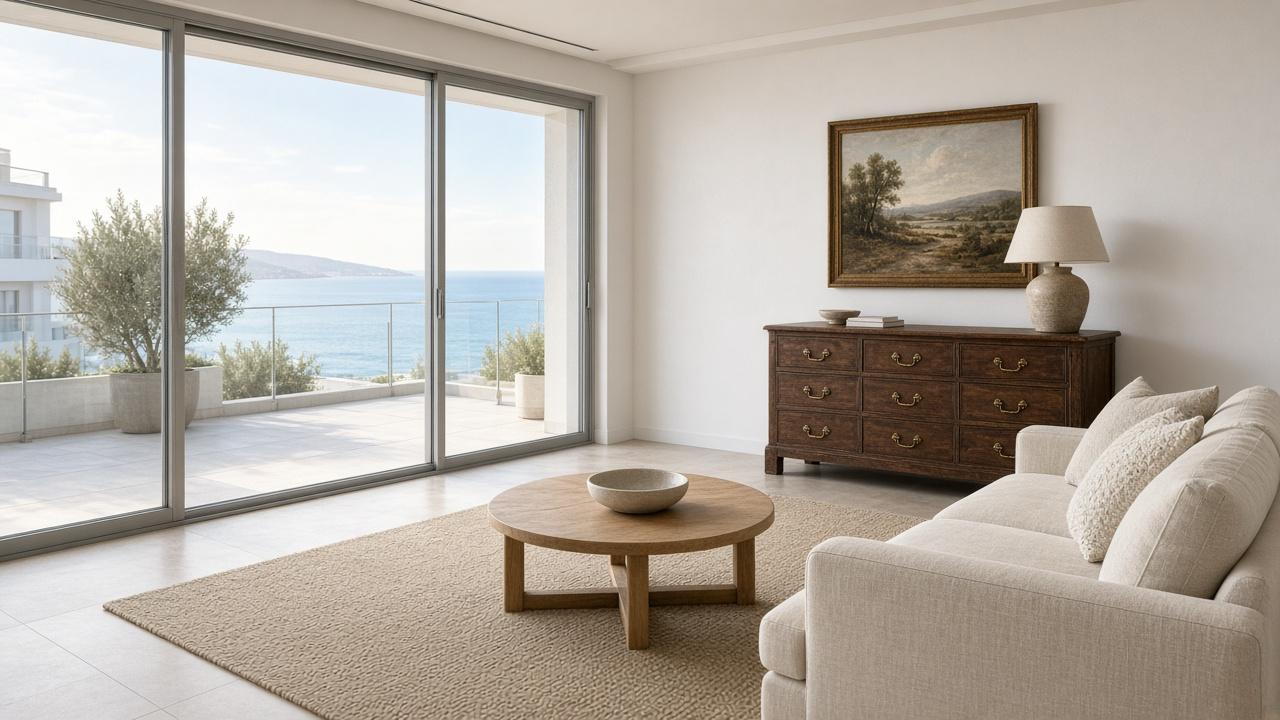
As a designer, I feel most strongly about this part. Furniture made for an American suburban house is usually built at a different scale. Sectionals are deeper, armchairs are wider, dining tables are longer and case pieces such as armoires and media cabinets are taller and heavier. In a house with large rooms and carpet, that scale looks generous. In a Costa del Sol apartment, it can swallow the room.
Most of the homes I furnish, from Benalmádena down to Manilva, are apartments, townhouses and villas with open-plan living areas, marble or porcelain floors, sliding doors to a terrace and a lot of light. The rooms are often smaller than the ones my American clients are leaving, and they rely on space around the furniture to feel calm. A sofa that is 110 centimeters deep and over three meters long leaves very little floor visible and can block the route to the terrace doors.
Before you decide to ship a large piece, check three things:
- The building. Measure the lift car, including the diagonal, and the narrowest doorway and turn on the way to the apartment. Many lifts in older buildings are small. Some pieces simply cannot go up.
- The room. Mark the piece's footprint on the floor plan of your Spanish home, then check that you still have a clear walkway, ideally around 90 centimeters, between the main pieces.
- The ceiling and walls. Tall bookcases and armoires may clash with lower ceilings, air conditioning units or radiators. Built-in wardrobes are standard in most new homes here, so a standalone wardrobe may be redundant.
Good furniture does not have to stay behind. Each large piece simply has to earn its container space by fitting a specific spot in a specific room.
Climate fit: salt, sun and humidity
The coast is kind to people and harder on furniture. The sun is strong for much of the year, homes near the sea live with salt in the air, and humidity can be high in apartments that are closed up between visits. That affects what I recommend shipping:
- Solid wood antiques can travel well, but they may react to a change in humidity. Keep them away from direct sun and from the terrace doors, and give them time to settle before you judge any movement in the joints.
- Heavy, dark upholstery, such as deep velvet or thick chenille in dark colors, can feel warm here in summer and will fade if it sits in front of a south-facing window.
- Thick wall-to-wall-style rugs made for carpeted rooms often feel too heavy on stone or porcelain floors, but a good wool or flatweave rug is usually worth bringing.
- Outdoor furniture from a dry inland climate may not cope with salt air. Terrace furniture deserves its own materials plan, and outdoor furniture is now included in every one of my packages.
I go into materials in more depth in my guide to choosing materials for the coastal climate, which covers wood, metal, fabric and stone near the sea.
Voltage, plugs and appliances
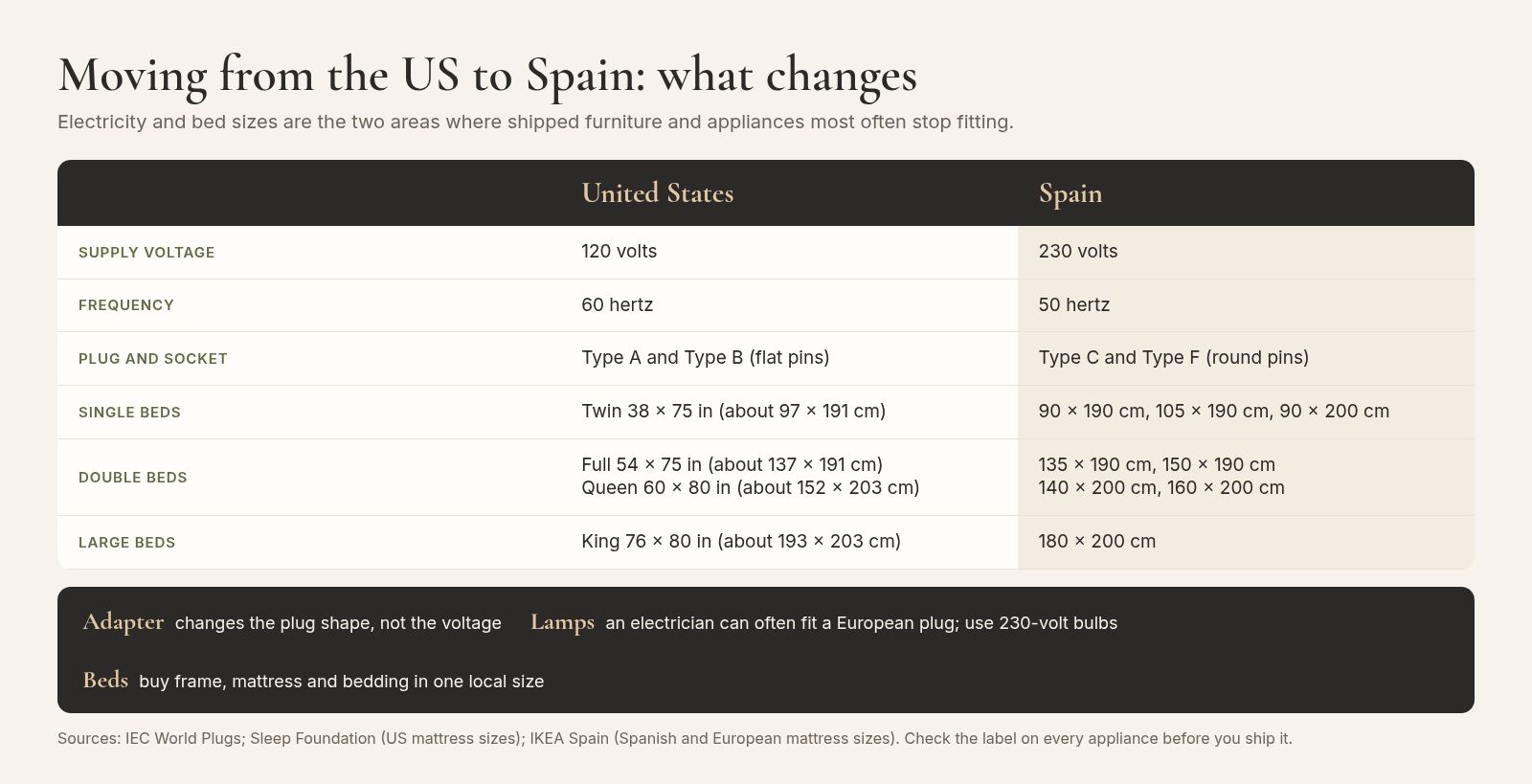
This is where shipping decisions become practical very quickly. Spain uses a 230-volt supply at 50 hertz, with Type C and Type F sockets, the round two-pin plugs used across most of continental Europe. The United States uses 120 volts at 60 hertz, with Type A and Type B plugs. A plug adapter changes the shape of the plug. It does not change the voltage.
Here is how I sort electrical items with clients:
- Dual-voltage electronics. Many laptop chargers, phone chargers and some small electronics are labeled for a range such as 100-240V and 50/60Hz. Read the label on each item. If it shows that range, a simple plug adapter is usually all it needs.
- Lamps. A table or floor lamp you love can often be made to work here by fitting a European plug and a bulb rated for 230 volts, provided the lamp's wiring and switch are suitable. Have a qualified electrician in Spain check and rewire it rather than doing it yourself.
- Anything with a motor, heating element or clock. Hair dryers, kitchen mixers, coffee machines, vacuums and similar appliances designed for 120 volts would need a transformer, and anything relying on 60 hertz timing may not run correctly at 50 hertz. In most cases I advise clients to sell or give these away before the move.
- Large appliances. American refrigerators, washers and dryers are usually built for a different supply and are often larger than the spaces in a Spanish kitchen or utility room. Most new homes here are handed over with a fitted kitchen, and replacements are easy to buy locally.
I am an interior designer, not an electrician, so treat this as a checklist and ask an electrician about anything you are unsure of.
Beds, mattresses and bedding sizes
Beds are where I see the most avoidable mistakes. Standard US mattress sizes are a twin at 38 by 75 inches, a full at 54 by 75, a queen at 60 by 80 and a king at 76 by 80. Converted, a US queen is about 152 by 203 centimeters, and a US king about 193 by 203.
In Spain, the common sizes are measured in centimeters, and you will see two families of sizes in shops. The traditional Spanish sizes are 90 by 190, 105 by 190, 135 by 190 and 150 by 190. The wider European sizes, such as 90 by 200, 140 by 200, 160 by 200 and 180 by 200, are now widely available too.
A US queen frame expects a mattress of around 152 by 203 centimeters, and none of the common sizes here matches it exactly. Ship the frame and every future mattress, fitted sheet and duvet cover becomes a special order.
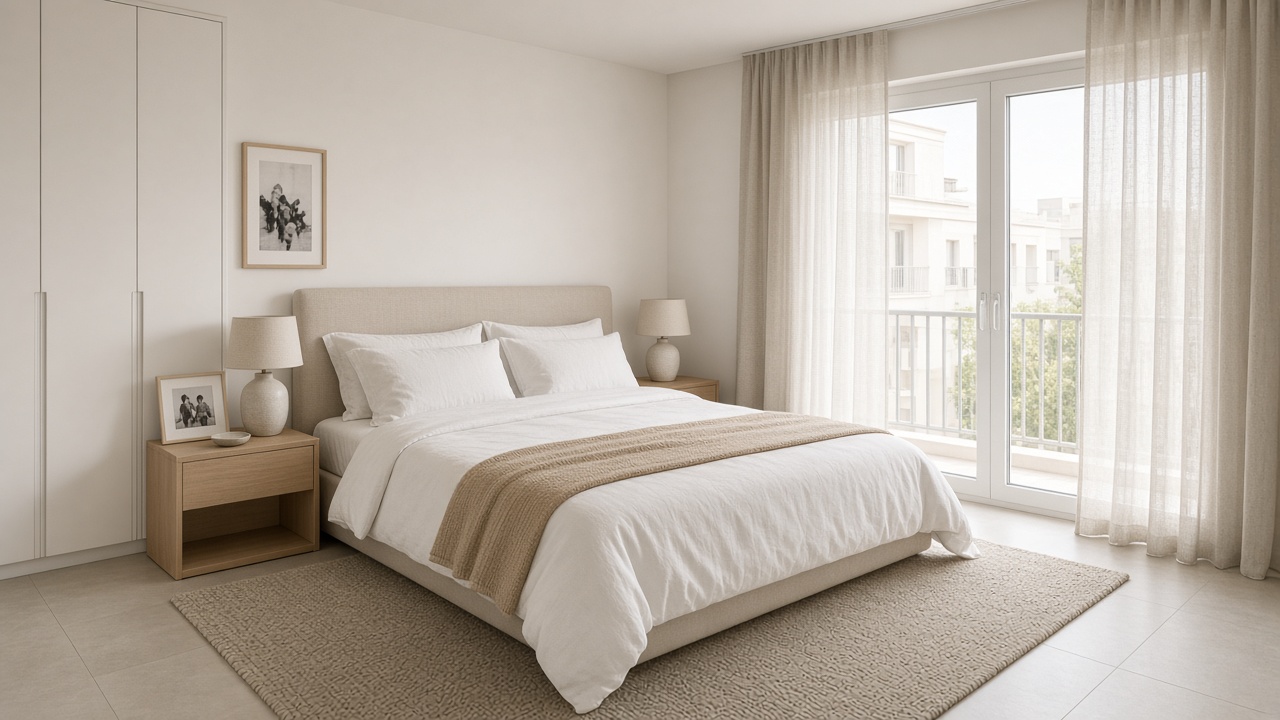
My advice is simple: do not ship bed frames or mattresses unless the frame is a genuine heirloom and you are prepared to have a mattress made to measure. Buy the bed and mattress here, in one of the local sizes, and you can buy bedding anywhere on the coast. If you have a headboard you love, it can sometimes be mounted on the wall above a new bed of a similar width.
Customs: the transfer of residence relief
If you are moving your main home to Spain from outside the European Union, which includes the United States and, since Brexit, the United Kingdom, the customs side is a significant part of the decision. I am not a customs agent or a tax adviser, and your mover's customs broker will handle the paperwork, but you should understand the broad rules before you decide what to ship.
The EU has a relief from import duty for personal property brought in by people transferring their normal place of residence from outside the EU, set out in Council Regulation (EC) No 1186/2009. Spain applies a matching exemption from import VAT in its VAT law, Ley 37/1992, articles 28 and 29. The Spanish Customs Department, part of the Agencia Tributaria, published updated guidance on the procedure in February 2026 (Nota Informativa 08/2026).
In broad terms, based on those official sources, the main conditions are:
- Twelve months outside the EU. You must have had your normal residence outside the EU for at least 12 consecutive months before the move.
- Owned and used for six months. The goods must have been in your possession and, for goods that are not consumables, used by you at your former home for at least six months before you left it.
- Same use, personal use. The items must be for your own personal or household use, used for the same purpose in your new home, and not in quantities that suggest a commercial purpose.
- Import within 12 months. The goods should be declared for import within 12 months of establishing your residence in Spain. They can arrive in several shipments within that period. They can also arrive before you move, if you commit to establishing your residence within six months, and customs may ask for a guarantee.
- No selling or renting for 12 months. For 12 months after the goods are cleared, they must not be lent, pledged, rented out or transferred without first informing customs.
- Exclusions. Alcoholic products and tobacco are excluded, along with commercial means of transport and professional equipment other than portable tools of your trade.
According to the Agencia Tributaria guidance, the application is made on the import declaration itself, with a detailed list of the goods, their estimated value and an approximate purchase date. You will need evidence of where you lived before, such as tax, utility or insurance documents, proof that you deregistered from your old residence, and proof of your new residence in Spain.
For furniture choices, this has two practical effects. First, the six-month rule matters if you were planning to buy new furniture in the US just before the move and ship it over. Second, keep receipts and photos of valuable pieces, because you may need to list values and dates.
There is also a separate Spanish VAT exemption, in article 30 of Ley 37/1992, for personal goods imported by private individuals to furnish a secondary residence. It requires, among other conditions, that you own the home, or rent it for at least 12 months, and that the goods are normal furniture and household items for that home. Customs duty treatment for second homes is a different question, so ask your customs broker about your own case.
If you are moving from another EU country, the customs relief above does not apply, because there is no customs border between member states. If you plan to let the apartment as a holiday rental soon after the move, discuss that with your adviser before you rely on the 12-month conditions.
What I would ship, and what I would leave
Once fit, climate, electricity and customs are on the table, the list usually sorts itself. This is the version I share with clients.
Worth shipping:
- Art, framed photographs and mirrors, properly crated.
- Good rugs, especially wool, silk or handmade pieces.
- Heirloom furniture that fits a measured spot in the new home: a chest, a writing desk, a pair of chairs, a dining table if the room can take it.
- Books, records and the small objects that make a home feel like yours.
- Quality kitchenware, table linens and serving pieces, provided they are not electrical.
- Lamps you love, if an electrician can make them safe for 230 volts.
Usually better left behind or sold:
- Oversized sofas, sectionals and recliners.
- Bed frames and mattresses in US sizes, and the bedding that goes with them.
- Large appliances and most small appliances built for 120 volts.
- Inexpensive flat-pack furniture that would cost more to ship than to replace.
- Heavy blackout drapes cut for American windows. Every window here is a different size, so curtains are measured on site.
- Outdoor furniture that was not designed for salt air.
The emotional pieces deserve the most care. The things that make a new home feel like yours are rarely the sofa or the bed. They are the painting from a grandparent, the rug they bought on a trip, the desk where they did their homework as a child. Those are the pieces I plan a room around, and they look better in a new home when everything around them is chosen to suit the light and scale of the coast.
The hybrid route: ship a little, furnish the rest
The route I recommend to most people sits in the middle: ship a short list of meaningful pieces and furnish the rest of the home here, so the apartment is ready when they arrive and the shipment is small enough to travel by groupage or a shared container rather than a full one.
This works well with a package. My packages are flexible: you can mix pieces between styles, choose colors and finishes, and I can put together alternative options around furniture you are keeping. If you are bringing a walnut dining table and a large rug, for example, I would design the living and dining area around them, perhaps in Mediterranean Calm, and leave out the pieces you already have. I have written more about that in furniture package vs buying piece by piece, and the full list of inclusions is in what is included in a furniture package.
The six-step process is designed for people who are still abroad. Most of it happens by video call, email and WhatsApp. You share your floor plan, a few photos and your move-in date, you receive a proposal with every piece listed room by room and a fixed price before anything is ordered, and the delivery, assembly and styling are coordinated for you. If you are furnishing before you arrive, my guide to furnishing a Costa del Sol home from abroad covers keys, access and how you will know the home is finished.
If you are not ready for a full project but want help deciding what to ship, my 2-hour in-home consultation costs €279. We walk through the home, measure the spots where your own pieces could go and agree what is worth the container space. For larger projects that include renovation or full interior design, see my design and renovation services.
Timing the shipment and the furnishing
If you do ship, think about the order of events. A container that arrives after the new furniture is installed is fine, as long as the plan already shows where each shipped piece will go. A container that arrives before the home is ready may need storage, which adds cost. Decide the shipping list early from the floor plan, get written quotes on that shorter list, ask each mover how customs clearance is handled at the Spanish end, and plan the new furniture around the pieces that are coming. If you can, have the new furniture installed before you land, so you are not camping in an empty apartment while the shipment is at sea. My furniture package FAQ answers the common questions on areas, curtains, IVA and customization.
Frequently asked questions
Can I bring my furniture to Spain without paying import duty?
Usually yes, if you are moving your main residence to Spain from outside the EU. You need at least 12 months of residence outside the EU, goods owned and used for six months, and import within 12 months of moving. The relief is claimed on the customs declaration, so ask your mover's customs broker to confirm your case.
Will my American lamps work in Spain?
Often, with changes. Spain runs on 230 volts at 50 hertz, while American lamps are built for 120 volts. A qualified electrician can usually fit a European plug and check the wiring and switch, and you then use bulbs rated for 230 volts. Do not rely on a plug adapter alone, because it does not change the voltage.
Do American sheets fit Spanish beds?
Not well. A US queen mattress is about 152 by 203 centimeters, while common Spanish double sizes are 135 by 190 and 150 by 190, with wider European sizes such as 160 by 200 also sold. Fitted sheets made for one size rarely sit properly on another, so I suggest buying bedding locally after the bed.
Is there VAT on furniture shipped to a holiday home in Spain?
Spanish VAT law has a separate exemption for private individuals importing personal goods to furnish a secondary residence. Conditions include owning the home, or renting it for at least 12 months, and importing normal household furniture. Customs duty can be a separate question, so check your situation with a customs broker before you ship anything.
Planning a move to the Costa del Sol
If you are weighing up a container against furnishing locally, send me your floor plan, a few photos of the pieces you are thinking of bringing and your move-in date. I will tell you which pieces I would plan around and what furnishing the rest would cost. You can book a call with me here, or email mirela@mirelabinteriors.com.