Furnishing a New Apartment in Estepona
A local guide to furnishing a new Estepona apartment: new builds, frontline and old-town flats, light, terraces and delivery logistics.
Many new apartments in Estepona are handed over with a fitted kitchen, finished bathrooms and nothing else. This is my local guide to furnishing one well: the property types, the light, the terraces, and the delivery details nobody mentions until the van is outside.
What do you need to plan when furnishing a new apartment in Estepona?
Plan four things before you order anything: a measured floor plan, the light in each room, the terrace as a full extra room, and access for the delivery. In Estepona that means lift and door sizes, your community's rules, and old-town streets. A complete two-bedroom package from me starts at €16,500 + IVA.
Estepona sits towards the western end of the stretch of coast I work in. I furnish homes from Mijas to Casares, and Estepona is right in that corridor, between San Pedro and Casares. Owners who buy here tend to arrive at the same moment: the keys are in hand, and every room apart from the kitchen and bathrooms is bare.
This guide covers the three kinds of apartment I see most often in the municipality, what Estepona's light and terraces mean for furniture, and how a whole home gets delivered, built and styled without anyone flying in to wait for a lorry.
Estepona at a glance, from a furnishing point of view
The town's own tourism office describes the municipality as having around 23 km of coastline, with seven old watchtowers spread along it. Behind the town rises the Sierra Bermeja, and in front of the centre runs the Paseo Marítimo, a promenade of nearly 3 km from La Rada beach to the fishing port. The town promotes its old town as "El Jardín de la Costa del Sol", the garden of the Costa del Sol, for its white streets lined with pots of flowers.
That geography matters for furniture, because each part of it produces a different kind of apartment. A flat on the hills above the A-7 with a long view to the sea has very different needs from a first-floor flat behind the promenade, or a whitewashed townhouse-style apartment a few streets from the Plaza de las Flores. The room sizes change, the light changes, the outdoor space changes and, more than anything, access for deliveries changes.
The three kinds of Estepona apartment I see most
I group Estepona apartments into three broad families. They are not official categories, just the way I think about a project when the floor plan lands in my inbox.
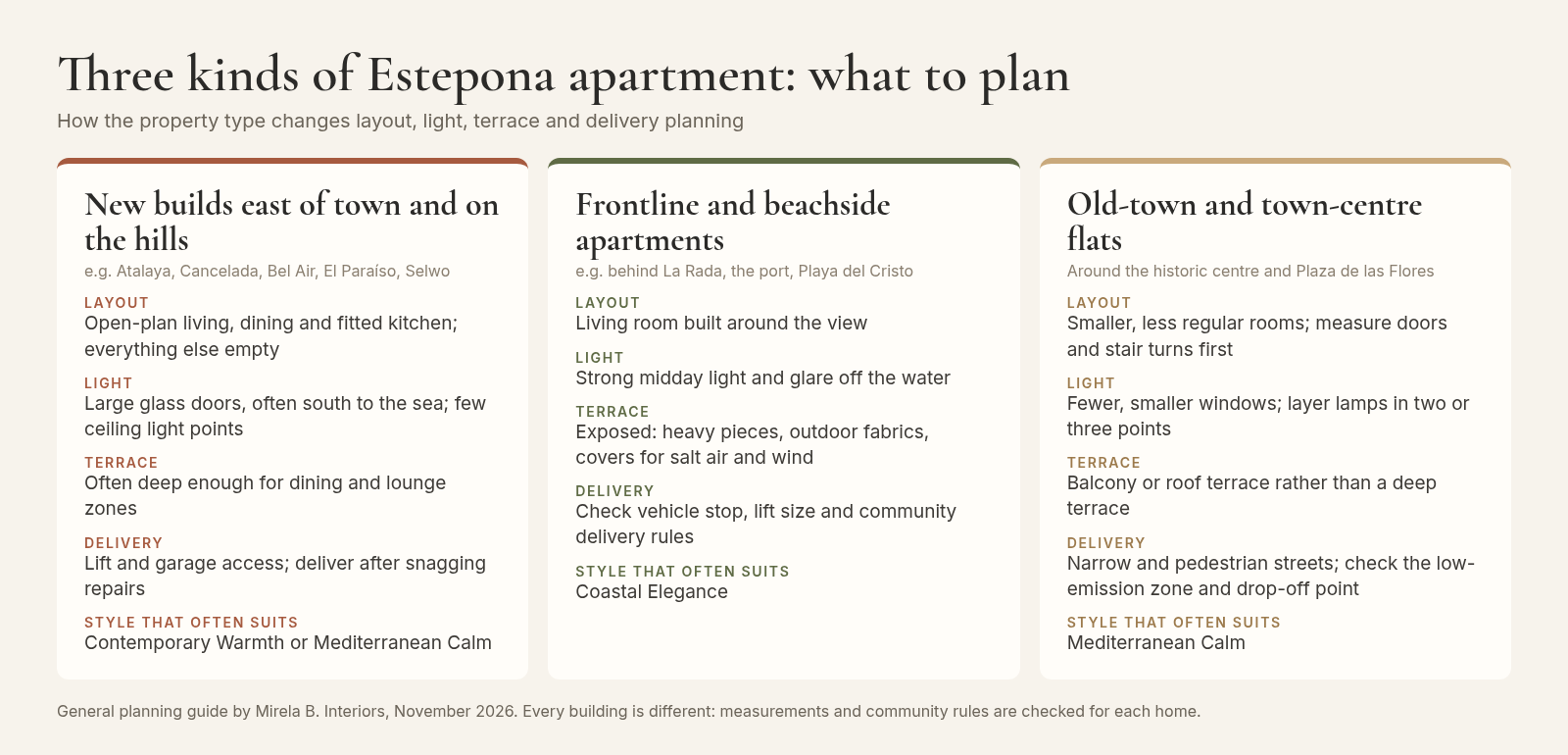
New builds east of town and on the hills
Much of the new construction is east of the town centre, along the stretch estate agents call the New Golden Mile. The name is a marketing label rather than an official district, and agents draw its edges in slightly different places, but it generally covers the corridor between Estepona town and the Guadalmina river at the Marbella boundary. It takes in areas such as Atalaya, Cancelada, Bel Air, El Paraíso and Selwo, with many of the newer complexes on the higher ground and a line of beachside communities closer to the sea.
New-build apartments here tend to share a pattern I know well:
- An open-plan living, dining and kitchen space, with the kitchen already fitted and every other area completely empty.
- Large sliding glass doors onto a terrace that is often as deep as a small room.
- Two or three bedrooms, each with fitted wardrobes, and bathrooms finished to the developer's specification.
- Ducted or split air conditioning already installed, and a limited number of ceiling light points.
- A garage space, a storage room and a communal lift serving the floors.
The usual challenge is that open-plan rooms with a lot of glass can feel like a showroom if the furniture is not arranged with care. The sofa needs to anchor the living area without blocking the route to the terrace, and the dining table has to sit where the light from the kitchen and the doors works for it, not wherever the developer happened to leave a pendant point.
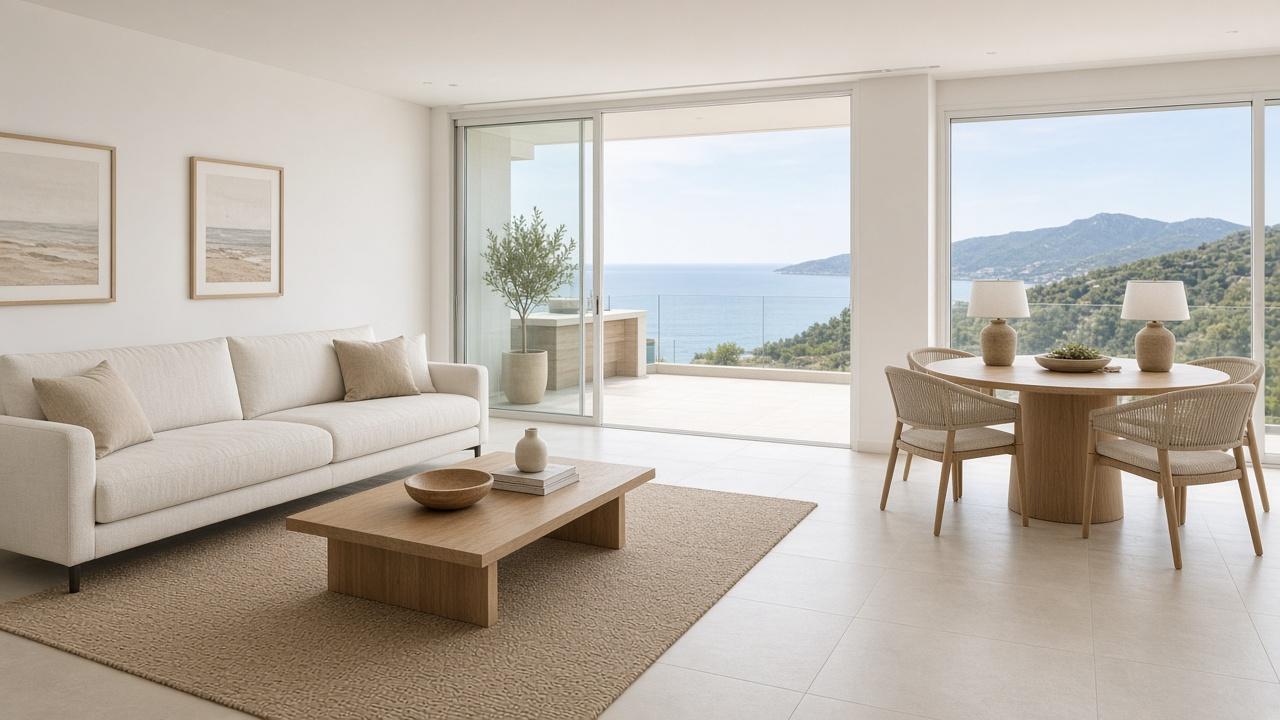
For these apartments I often suggest Contemporary Warmth, with its darker woods, clean lines and warm neutrals, because it gives a crisp new interior some depth. Mediterranean Calm works just as well if you want the room lighter and softer.
Frontline and beachside apartments
The second family is the apartment on or near the sea: blocks along the promenade behind La Rada, around the port and the Playa del Cristo, and in the beachside communities that run east and west of town.
These homes are about the view, and the furniture should not compete with it. I keep seating low enough that the horizon stays in sight from the sofa, choose tables that do not stand between the room and the glass, and avoid anything with a high back facing the windows. I also think hard about what the sea air does to materials, which I come back to below.
This is the natural home of Coastal Elegance: crisp whites, soft stone and cement-look surfaces, with blue brought in through textiles, lamps and ceramics rather than painted on the walls. My rule here is restraint. No shells, no anchors, no rope. The sea is outside the window, so it does not need to be on the cushions too.
Old-town and town-centre flats
The third family is the apartment in or near the old town: white façades, iron balconies, narrower rooms and sometimes a roof terrace instead of a balcony. Some are in older buildings that have been reformed, others in newer blocks built within the existing street pattern.
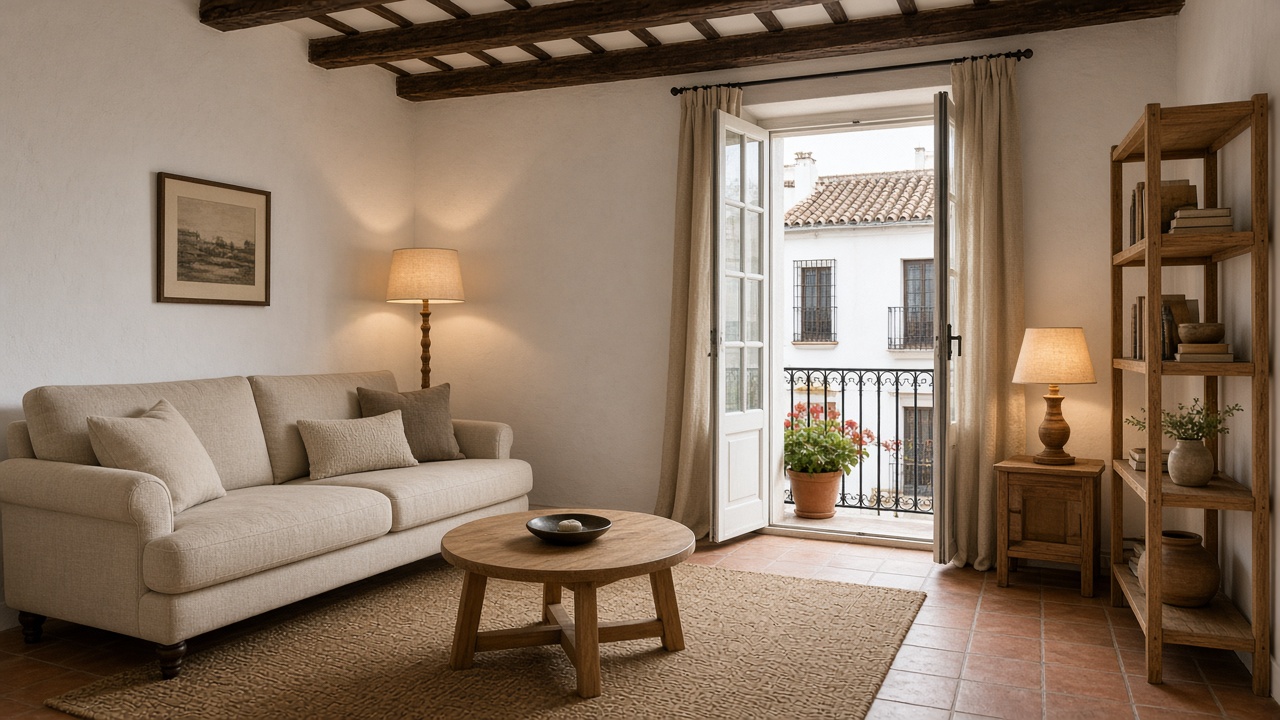
These homes have character that a new build cannot copy, but they ask more of the planning. Rooms are smaller and less regular, windows are fewer and smaller, and walls are not always straight. A three-seater sofa that looks modest in a showroom can overwhelm a living room that is three metres wide. I measure doorways, stair turns and lift cars before anything else is decided, and I would much rather specify a slightly smaller sofa that fits beautifully than a larger one that has to be hoisted over a balcony.
Mediterranean Calm, with light oak, soft linen and warm whites, tends to suit these interiors because it adds light rather than taking it away.
Light: what the Estepona sun does to a room
Light is the first thing I ask about, even before I ask about budget. I want to know which way the main windows face, whether there is a building or a hill opposite, and whether the terrace is covered.
On the hills and the frontline, many apartments face roughly south towards the sea, which means strong, high light in the middle of the day and a lot of reflected glare off the water and pale terrace tiles. Apartments that face west get the low afternoon sun straight into the living room. In the old town, the opposite happens: narrow streets and small windows mean some rooms see very little direct sun at all.
Each of those situations changes what I specify:
- Bright south and west rooms. I choose upholstery and rugs in colours and fibres that will age gracefully in strong sun rather than fade unevenly, and I plan for window treatments early. Curtains are not part of a package's starting price, because every window is a different size, so I measure and quote them for your home. In a west-facing living room, I would not leave them off.
- Darker old-town rooms. I lean on warm whites, light oak and lamps placed in at least two or three points in the room, so the space is not lit by one ceiling fitting.
- Open-plan new builds. I place lighting where people actually sit and eat. Spanish new builds often come with a single ceiling point per area. If you want pendants over bedside tables or a different position over the dining table, your electrician installs the light points and I prepare the layout so they know exactly where.
If you want to go further into the materials question, I wrote a separate piece on choosing materials for the coastal climate, covering fabrics, metals and finishes near the sea.
Terraces are a room, so furnish them like one
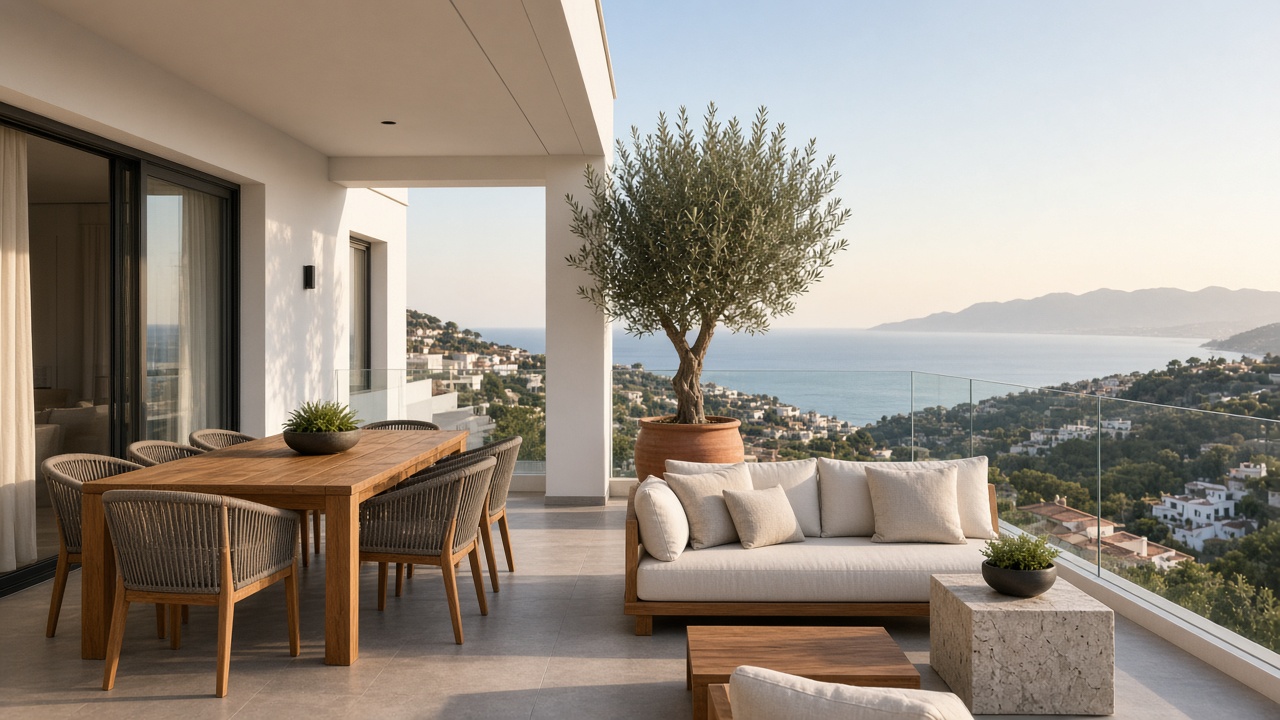
In Estepona, the terrace is often the room you use most. For a large part of the year it is where breakfast, lunch and the evening drink happen. Yet it is the space owners most often leave until last, and then fill with whatever the nearest garden centre has in stock.
Outdoor furniture is included in every one of my packages, designed for the terrace, balcony or garden you actually have. Here is how I think about it.
Measure the usable depth, not the advertised area
A developer's brochure gives a terrace area in square metres. What matters for furniture is the clear depth from the glass to the balustrade, minus the swing of any door and the space needed to walk past. A long, narrow terrace of two metres deep can take a bistro table and two loungers. Add a metre and you can have a proper dining table for four or six. I plan the layout from a floor plan and photos, not from the brochure figure.
Split it into zones
On a terrace of a reasonable size I like two clear zones: a dining area near the kitchen side, and a lounge area where the view is best. Even on smaller terraces, one comfortable chair with a side table in the right corner gets used far more than a table nobody has room to pull out a chair from.
Choose for sun, wind and salt
Frontline and hillside terraces can be exposed. I choose outdoor pieces that are heavy enough not to move in a strong breeze, with frames and fabrics meant to live outside, and cushions that can be brought in or covered when you leave for a few weeks.
What to plan before anything is ordered
Good furnishing starts with planning, not shopping. This is the order I work in.
A floor plan with real measurements
The sales plan from the developer is a start, but I want the measured dimensions of each room, the position of doors and windows, and the height of any windowsills. For older apartments I ask for a few photos with a tape measure in shot, or I arrange for measurements to be taken.
Where the power and air conditioning are
Sockets decide where lamps and the television can go. Air-conditioning units decide where a tall headboard or a large piece of art cannot go. I mark both on the plan before I place a single piece.
How you will use the home
A home you live in all year, a second home you visit for a few months, and a holiday rental are three different briefs. A rental needs fabrics that clean easily, enough seating and dining for the number of guests, and a layout that photographs well. If you plan to let, my article on what Andalusia's holiday rental rules require inside the apartment goes through the official list in detail.
The community's rules
Before you plan a holiday let, read your building's statutes (estatutos). In a resolution published in Spain's official gazette, the BOE, on 23 February 2026, the Dirección General de Seguridad Jurídica y Fe Pública confirmed an Estepona land registrar's refusal to assign a short-term rental registration number to a flat because the building's registered statutes banned "any kind of business" in the homes. I am not a lawyer, and you should take advice on your own building, but it is a good reminder that the statutes matter as much as the décor.
Your timing
Tell me when you want to arrive, or when the first guests are due. My process is built around a reserved installation date, and everything else is planned backwards from it.
Delivery logistics in Estepona
Access to the building
For every Estepona project I check:
- The width and height of the main door, the lift car and the apartment door.
- Whether the lift is big enough for a sofa and a mattress, or whether some pieces will need to go up the stairs.
- Where a delivery vehicle can stop, and how far it is from that point to the building entrance.
- Whether the community asks for notice of deliveries, protection on the lift walls, or delivery during particular hours.
The last point varies from building to building, so I ask the administrator or the property manager rather than assume. Many communities are perfectly relaxed; some have firm rules, and it is much easier to follow them than to apologise afterwards.
The old town and the low-emission zone
The old town is lovely to walk through and less lovely to reverse a lorry into. Many streets are narrow, some are pedestrian, and planters line the façades. Estepona's town hall has also approved a low-emission zone (Zona de Bajas Emisiones) covering about 60 hectares, most of the historic centre, bounded by Avenida de Andalucía, calle Tajo, calle Pilar de Farinós, Avenida de San Lorenzo and the seafront. The ordinance lists loading and unloading vehicles among those exempt from the restrictions.
The sources I read disagree on how far the zone is being enforced in practice, and the rules can change, so I do not plan around a single article. For an old-town apartment I check the current position with the town hall and the delivery team before booking a date, and I plan the drop-off point and the distance to carry. Sometimes that means smaller vehicles, an earlier start, or furniture chosen partly for the way it comes apart.
New builds: snagging and handover
For a brand-new apartment, I prefer to deliver after the snagging list has been dealt with. Furniture in a room makes it harder for the developer's team to repaint a wall or replace a floor tile, and it is better for everyone if repairs happen in an empty space. Planning, the proposal and the orders can all happen while that work is being finished.
Someone to open the door
You do not need to be in Spain on delivery day. If you are abroad, a key holder, your property manager or your agent can let the team in, and I coordinate with them directly. Delivery, assembly, installation and final styling are all included, so there are no separate transport fees or handyman bills. When everything is in place, you receive photos and a video walkthrough.
Distance from the airport
Estepona is roughly 80 km from Málaga airport by road, which is worth remembering if you are planning to fly in for one day to meet a delivery. It is also why my process does not need you there on the day.
Essentials or Elevated: which package suits an Estepona apartment?
I sell complete furniture packages in three styles, and each style comes at two levels. The package prices are published and fixed in your proposal before anything is ordered.
Essentials Furniture Package, for holiday rentals, investors and anyone who wants a fast, stylish setup that can take regular use:
- Two bedrooms: from €16,500 + IVA
- Three bedrooms: from €19,990 + IVA
- Each extra bedroom: €2,995 + IVA
Elevated Furniture Package, for owners who live in the home or want a premium finish, with upgraded materials, upholstery and lighting:
- Two bedrooms: from €25,500 + IVA
- Three bedrooms: from €29,990 + IVA
- Each extra bedroom: €3,995 + IVA
Prices are shown before IVA, which is added at the current rate on your invoice. Every package includes design and selection of furniture, lighting, rugs and decor, the living room, dining area and bedrooms, outdoor furniture for your terrace, delivery, assembly, installation and final styling, one English-speaking contact from the first call to the final placement, a live plant chosen for your light, and welcome gifts.
I do not match packages to Estepona properties by postcode. A frontline two-bedroom that will be let all summer is usually an Essentials project, because durability and easy cleaning matter more than a more expensive sofa. A hillside apartment that a couple will live in for half the year often suits Elevated, because they will notice the upholstery and lighting every evening. You can also swap any piece for one from another style at the same package level at no extra cost, so an old-town flat can have a Mediterranean Calm living room with a Coastal Elegance dining table if that is what works.
If you want to see how these numbers compare with buying everything yourself, I set out the full arithmetic in how much it costs to furnish an apartment on the Costa del Sol.
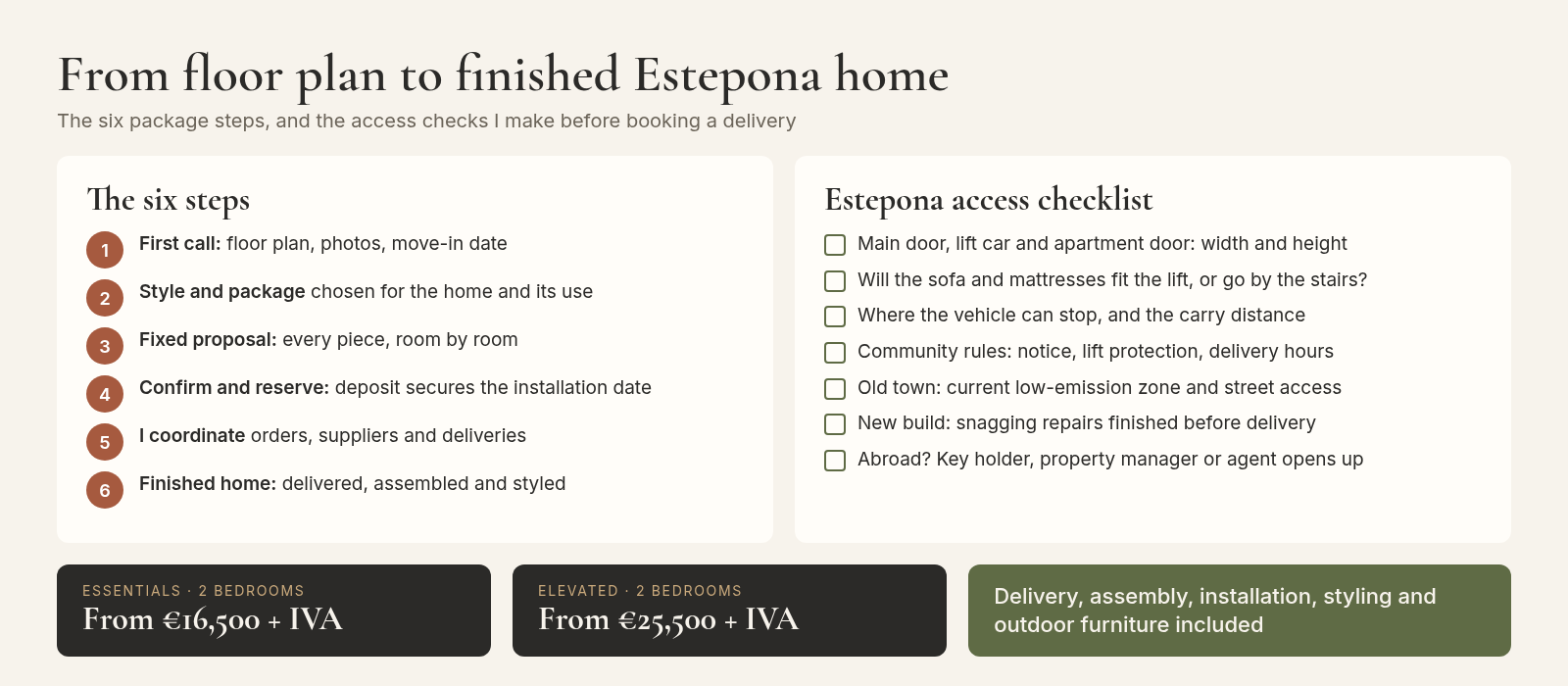
How a furniture package works for an Estepona apartment
The process is the same wherever you are on the coast, and most of it happens by video call, email and WhatsApp. The six steps are set out here, but in short:
- A first call. You share your floor plan, a few photos and your move-in date.
- Style and package. I recommend the best fit for the apartment and the way you will use it.
- Your proposal. You see every piece, room by room, with a fixed price before anything is ordered.
- Confirm and reserve. You approve the proposal and pay a deposit to secure your installation date.
- I coordinate everything. Orders, suppliers and deliveries, with updates by WhatsApp.
- Your finished home. Delivered, assembled and styled, with a live plant and welcome gifts.
For Estepona specifically, step two is where the property type matters most, and step five is where the access checks above happen. I would rather discover a narrow lift in the planning than on the day.
If you are not ready for a full package and want a designer's eyes on the apartment first, I also offer a 2-hour in-home consultation for €279 across the Costa del Sol, covering layout, renovation ideas and presentation. Owners who are furnishing from overseas may also find my guide to furnishing a Costa del Sol home from abroad useful.
A few opinions I hold about Estepona apartments
A few views I hold firmly when I plan an apartment here:
- Buy the rug size the room needs, not the one in stock. In open-plan new builds, an undersized rug makes the living area look as though it is floating. The front legs of the sofa and chairs should sit on it.
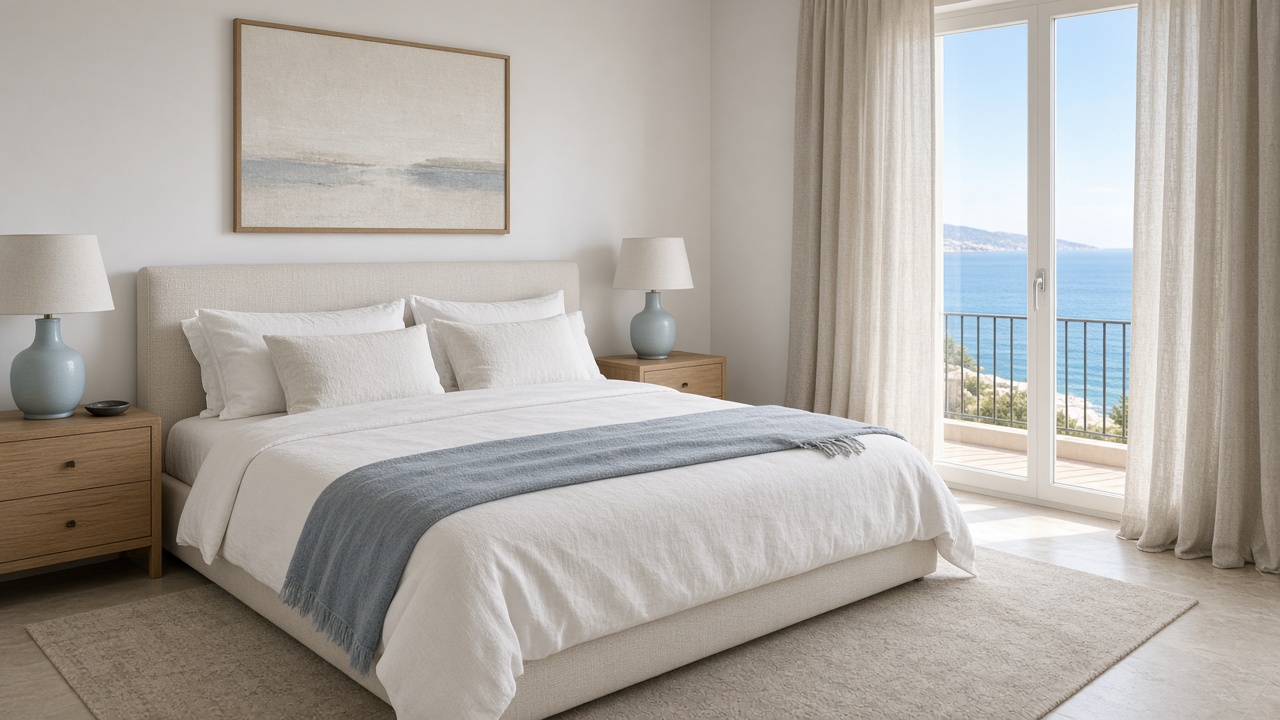
- Bedrooms should be calmer than living rooms. Strong light outside means the bedroom should feel cool and quiet: linen, soft colours, and curtains that actually close.
- Do not theme it. Estepona has a real town, real streets and a real sea. The interior does not need to imitate any of them.
Frequently asked questions
Can furniture be delivered to an apartment in Estepona's old town?
Yes, but it needs more planning than a new build. Streets are narrow, some are pedestrian, and the town hall's low-emission zone covers most of the historic centre, although its ordinance exempts loading and unloading vehicles. I check current access rules, the drop-off point and the carrying distance before booking a delivery date.
Should I wait until snagging is finished before furnishing a new build?
I recommend delivering after the snagging repairs are complete, because painters and tilers work faster and more carefully in empty rooms. The design, proposal and ordering can all happen while the developer finishes the list, so you lose very little time. Reserve your installation date once the handover and repair dates are firm.
What terrace furniture works on a frontline apartment in Estepona?
Choose pieces heavy enough to stay put in a strong breeze, with frames and fabrics made for outdoor use near salt air. Measure the clear depth from the glass to the balustrade before choosing a dining table. Cushions that can be stored or covered make a big difference when you are away for weeks.
Can I start planning the furniture before I get the keys?
Yes. With the developer's floor plan, the room dimensions and a few photos or renders, I can recommend a style and prepare a fixed proposal before completion. I confirm the key measurements once the apartment is built, especially lift, door and terrace sizes, and the installation date is then reserved around your handover.
Let's plan your Estepona apartment
If you have just bought in Estepona, or you are about to, send me the floor plan, a few photos and the date you would like to walk in. I will tell you which package fits, which style suits the light and the view, and exactly what it will cost, with delivery, assembly and styling already in the price.
You can book a call with me here, message me on WhatsApp at +34 664 276 642, or email mirela@mirelabinteriors.com.