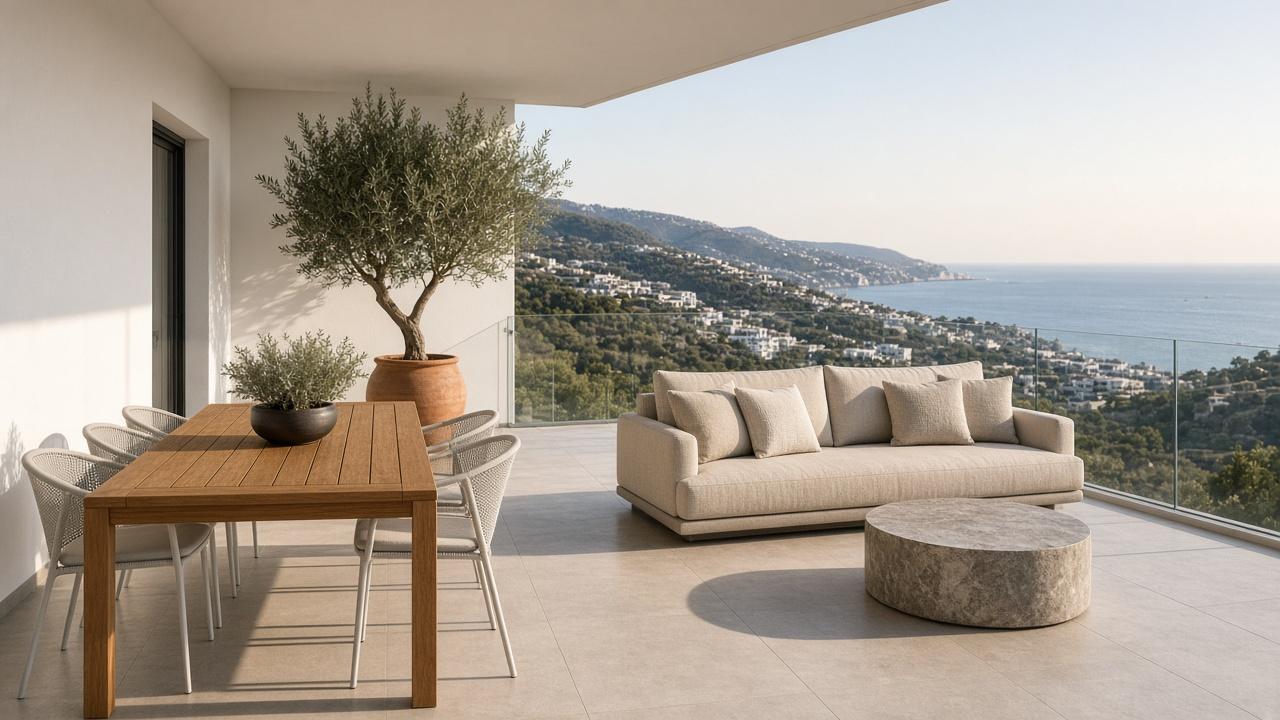
Terrace Furniture That Survives Sun, Salt and Wind
The terrace furniture I trust on the Costa del Sol: teak, aluminium, rope and outdoor fabrics that cope with sun, salt and wind, plus winter care.
On this coast the terrace is often the room you use most, and it is the one the weather works on hardest. This is how I choose outdoor furniture that still looks good after a few summers of strong sun, salty air and the odd gusty afternoon.
Which terrace furniture lasts longest on the Costa del Sol?
Frames in good powder-coated aluminium or solid teak, fittings in 316 stainless steel, cushions in solution-dyed acrylic over quick-dry foam, and pieces heavy or low enough to sit still in a gust. Then one habit: rinse the salt off with fresh water regularly and store cushions dry when you are away.
Outdoor furniture is where I see the biggest gap between what looks good in a showroom and what still looks good after two summers on a terrace in Mijas, Marbella or Casares. I am an interior designer, not a metallurgist, so what follows is the practical knowledge I use when choosing outdoor pieces, checked against what manufacturers and industry bodies actually say.
What the coast does to outdoor furniture
A material that shrugs off one of these three forces can struggle with another.
Sun: colour, surfaces and heat
Ultraviolet light breaks down pigments and the surface of many materials. On fabrics it shows as fading, first on the top of the seat cushion and the side facing the sea. On wood it turns the surface grey. On cheaper plastics and resin weaves that were not made with UV stabilisers it shows as chalkiness, then brittleness, then cracking.
There is also heat. A dark metal frame in full afternoon sun in July can get uncomfortably hot to touch, and a black cushion soaks up heat in a way a sand-coloured one does not.
Salt: the slow one
Salt is quieter than sun. It settles on every surface as a fine film, and sea salt has an unhelpful property: it holds on to moisture and stays damp at much lower humidity than you would expect. The Australian Stainless Steel Development Association describes this when it explains why salt is one of the main causes of "tea staining", the brown surface marks you sometimes see on stainless steel by the sea. They also note that it occurs most commonly within about five kilometres of the surf, and on this narrow coastal strip a great many homes sit inside that line.
Salt finds the weak points: a chip in a coating, a cheap screw, a joint that traps water. Rain-sheltered surfaces are often worse than exposed ones, because nothing rinses the salt away, which matters on the covered terraces common in new developments here.
Wind: the one owners underestimate
The Costa del Sol has named winds. AEMET, the Spanish state meteorological agency, describes the terral in Málaga as a land wind from the north-west that comes down off the mountains, hot and very dry in summer and gusty in winter. The levante blows from the east, and the poniente from the west. A meteorologist writing in AEMET's own bulletin described how the levante gathers strength as it approaches the Strait of Gibraltar, worth knowing at the western end of my area, around Estepona, Casares and Manilva, if your terrace faces east.
In practice, wind moves light furniture, turns an open parasol into a sail and drives salt and dust into every gap. On upper floors and frontline buildings, all three get worse.
I wrote more generally about specifying for the climate in my guide to the best materials for coastal homes, which covers floors, paint, metals and wood indoors; this is the outdoor furniture version.
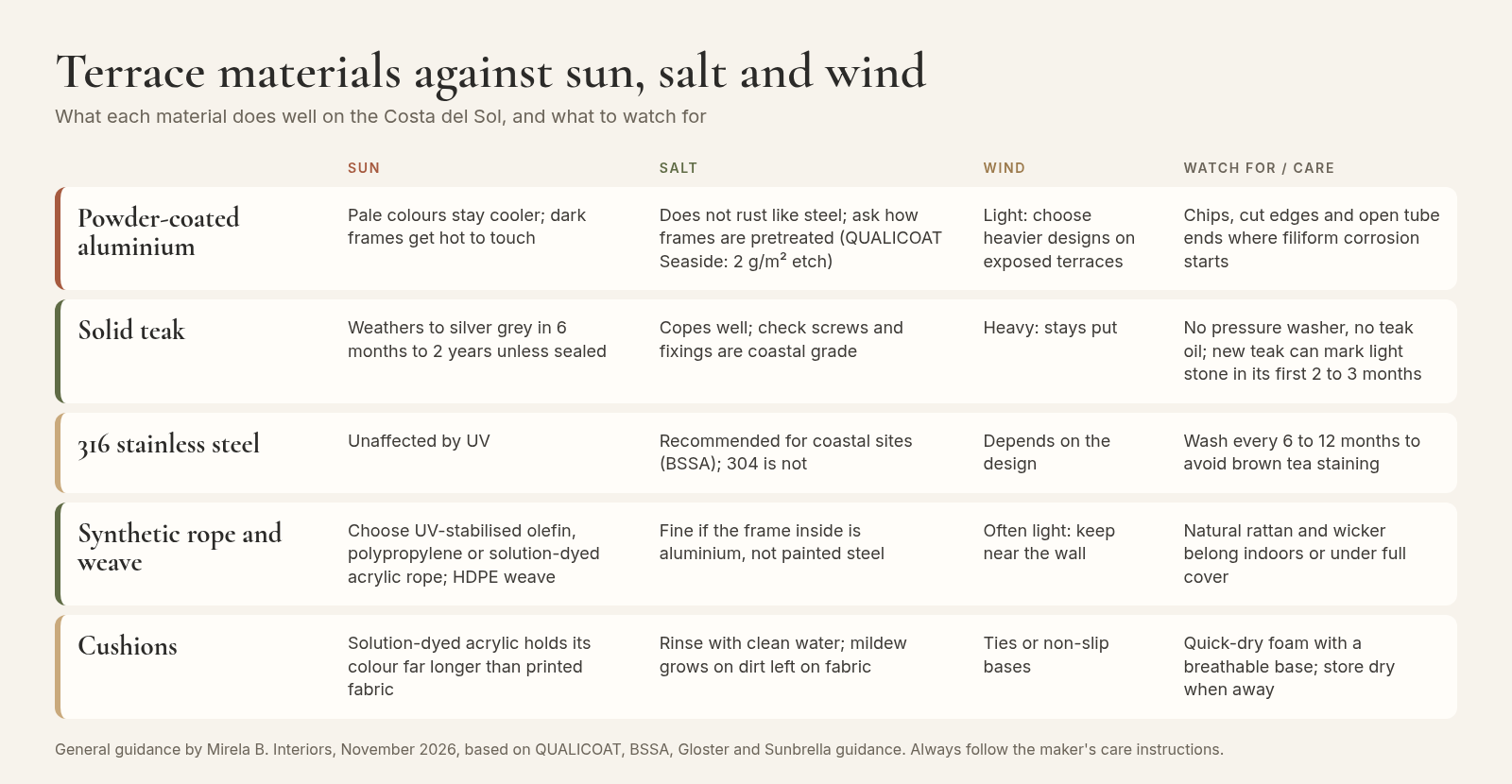
Frame materials, one by one
The frame decides how long a piece lives. Cushions can be replaced; a corroded frame usually cannot be saved.
Powder-coated aluminium
Aluminium is light, it does not rust the way steel does, and it takes a powder-coat finish in almost any colour. It is my most frequent choice for terrace dining chairs and lounge frames, but quality varies far more than the showroom suggests, and the difference is mostly invisible.
A powder coating depends on how well the aluminium was prepared before it was coated. QUALICOAT, the quality label for architectural coatings on aluminium, explains that untreated or poorly prepared aluminium can keep oxidising under the coating. By the sea, the typical failure is filiform corrosion: fine, thread-like lines that creep under the paint, usually starting from a cut edge, a scratch or a chip. QUALICOAT's "Seaside" class exists for exactly this. It requires a deeper etch of the metal during pretreatment, at least 2 g/m² removed instead of the standard 1 g/m², plus an extra filiform corrosion test. QUALICOAT UK & Ireland recommends Seaside class for projects within 5 km of the coast there.
Most outdoor furniture brands do not print their pretreatment on the price tag, so I ask. A supplier who can tell me how the frames are pretreated and what coating standard they meet gets my business. One who answers "it's aluminium, it doesn't rust" does not.
Also look at the feet: an open tube end that collects water, or a glide that scratches through the coating every time the chair moves, is where trouble starts.
Teak
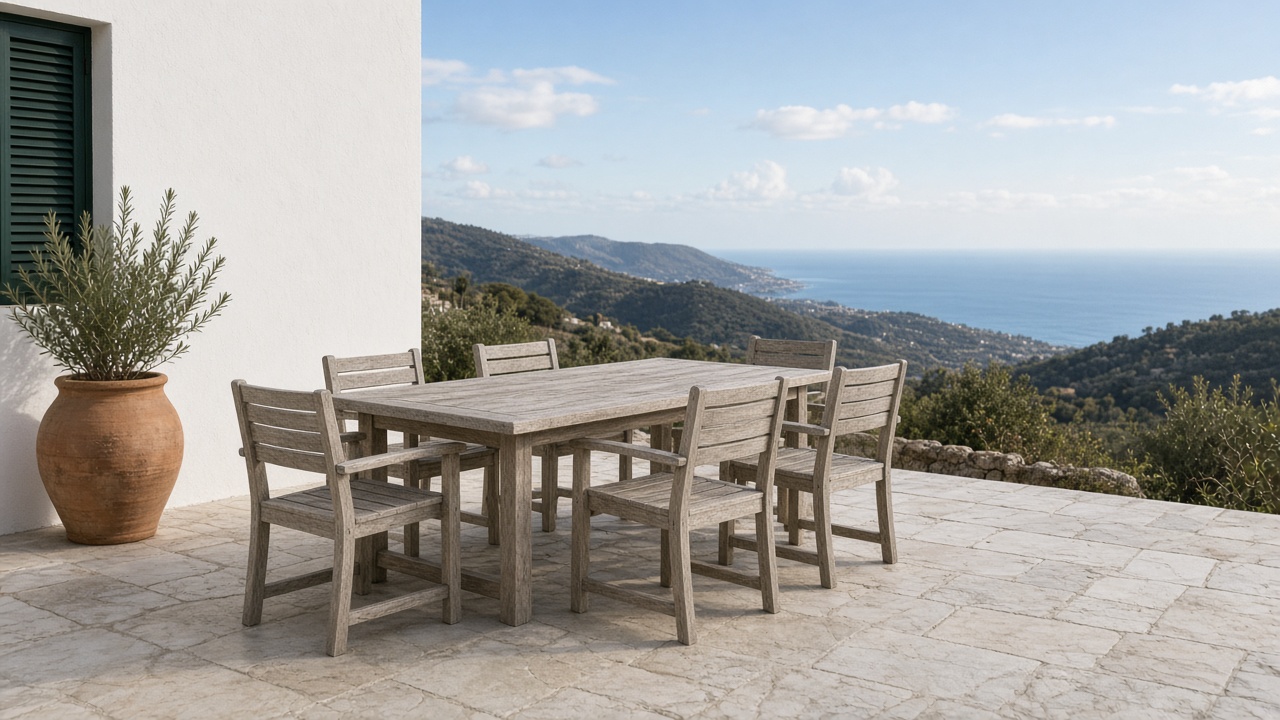
Solid teak is still the outdoor timber I trust most. It is a dense hardwood rich in natural oils, and the better outdoor furniture makers say it needs no coating to last outside. What it does do is change colour. Gloster, one of the long-established teak furniture makers, describes how sunlight and rain fade the surface from golden brown to silver grey, typically over six months to two years depending on exposure. That grey is a surface change, not decay.
You have two choices. Let it go silver, which I like on a terrace with white walls and pale stone, or keep the honey colour with a teak sealer applied when the furniture is new and reapplied at least once a year. Gloster advises against teak oil, because extra oil can encourage mildew and turn the surface black. They also say never to use a pressure washer, which can erode the softer surface of the wood and leave it rough. I mention this to every client, because pressure washers are everywhere here.
One detail that matters on Costa del Sol terraces in particular: new teak releases natural oils and pigment when it first gets wet, for roughly the first two to three months. Gloster recommends keeping new teak off light-coloured porous stone during that period, and away from pale cushions in wet weather. If your terrace is laid in a light natural stone, put felt pads or a rug under new teak legs and wait out the first rains.
Teak is heavy, which is a real advantage in the wind. It also stays more comfortable to touch than metal in strong sun.
Stainless steel
Stainless steel turns up in frames, table bases, and in the screws, bolts and hinges that hold almost everything else together. The grade matters. The British Stainless Steel Association recommends the molybdenum-alloyed grade 1.4401, better known as 316, wherever there are noticeable amounts of chlorides in the air, and names coastal locations specifically. The common grade 304 is fine for many inland uses, but their care guidance lists it as not recommended for coastal or marine locations.
"Marine grade" is an informal sales label rather than a standard, and even 316 needs regular care by the sea. The same BSSA guidance suggests cleaning stainless steel in coastal settings every 6 to 12 months, with mild soap and warm water, then a clean-water rinse, and more often if you see salt deposits or staining. The Australian association calls tea staining a cosmetic issue, but it still looks shabby.
I check the fixings as much as the frame. Low-grade screws in a teak bench will streak the wood with rust long before the timber has any problem.
Rope and synthetic weave
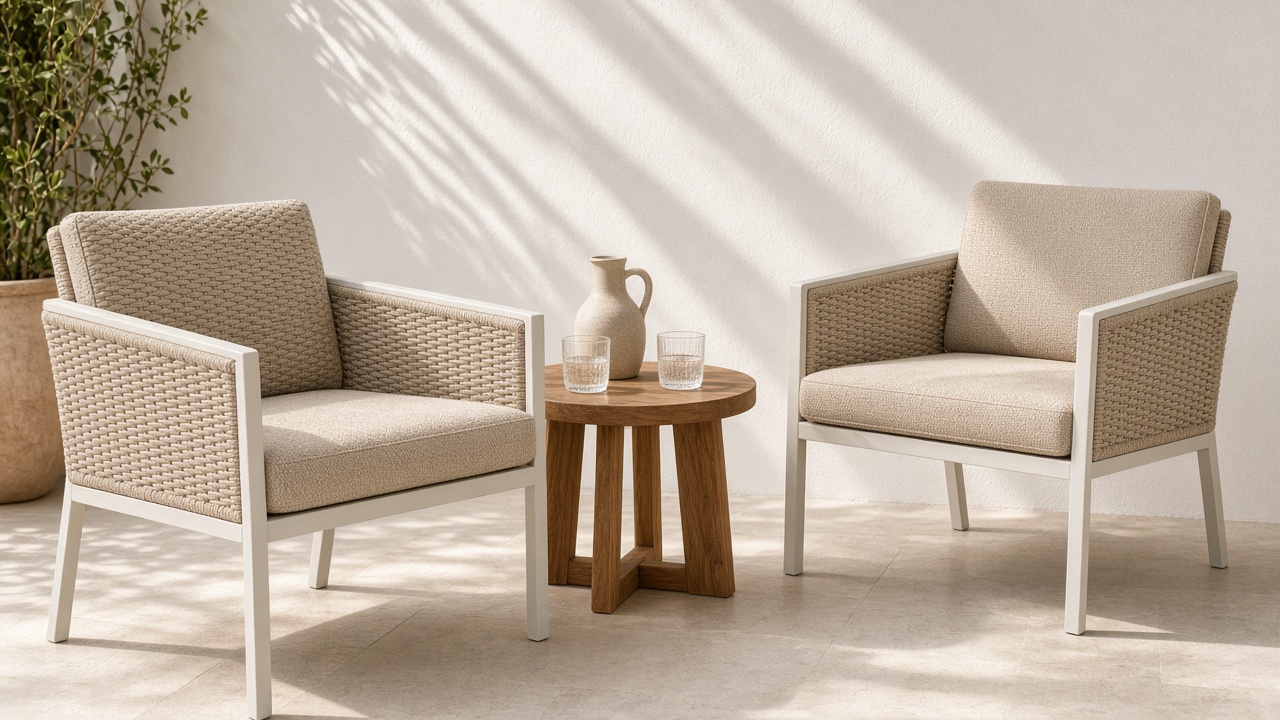
Rope-wrapped chairs and woven loungers are popular, and they can last well outside if the fibre is right. What you want is a synthetic made for outdoor use and UV-stabilised: solution-dyed acrylic rope, or olefin and polypropylene rope with UV stabilisers. For woven pieces, the outdoor standard is a synthetic weave such as high-density polyethylene, coloured through and made for exterior use, rather than natural rattan, which belongs indoors or under full cover.
The weave is only as good as the frame underneath it. I want aluminium under the rope, not painted steel, because if the frame corrodes inside the wrapping you will not see it until it fails.
Tops: glass, ceramic and stone
For dining tables I like ceramic or sintered stone tops on an aluminium or teak base: heavy, colourfast and unbothered by sun cream or wine. Glass tops should be toughened safety glass, and on a sunny terrace they show every salt mark and water ring.
What I avoid on the coast
- Powder-coated steel frames anywhere near the sea, because once the coating chips, the steel underneath rusts.
- Untreated iron and decorative wrought iron outdoors, unless the client accepts regular repainting.
- Natural rattan, wicker and seagrass on an open terrace.
- Cheap printed polyester cushions, which fade fast in direct sun.
- Lightweight stacking chairs on upper floors and windy corners.
Cushions and outdoor fabrics
Cushions get more abuse than anything else on a terrace: sun on top, damp underneath, sun cream and salt. Get the cover and the filling right.
Solution-dyed acrylic covers
Solution-dyed means the colour is added to the fibre before it is spun, rather than printed or dyed onto the finished fabric. Sunbrella, the best-known brand, describes its fibres as saturated with UV-stabilised pigments before they are spun into yarn, so the colour runs right through. That is why these fabrics hold their colour far longer in direct sun than a printed fabric, where the colour sits on the surface.
Solution-dyed acrylic resists fading, but it is not indestructible. Sunbrella itself says its fabrics do not promote mildew, but mildew can grow on dirt and other substances left on the fabric. Sunbrella's own advice is to brush off dirt before it gets embedded, rinse regularly with clean water, use mild soap with a soft brush when needed, avoid hard scrubbing and always let the fabric air dry.
On colour, I lean towards sand, stone, oatmeal, warm white and soft olive. They forgive dust and salt, they stay cooler than dark tones, and they sit naturally with white render and terracotta. I covered fabric fading indoors in my Costa del Sol decorating tips, and the same colour logic works outside.
Quick-dry foam inside
The filling matters as much as the cover. Standard upholstery foam soaks up water like a sponge and can stay damp inside a cushion long after the rain, which is how mildew starts. Quick-dry foam, also called reticulated foam, has an open cell structure that lets water run straight through and air dry it out. It is not waterproof. It drains, and it only works if the cushion has a breathable or mesh base and sits on a frame that lets water away.
I also prefer cushion covers with zips, so they can be taken off and washed, and ties or non-slip bases on seat cushions so a gust does not lift them.
Planning a terrace for the wind
The wind damage I worry about most is what furniture does when it moves: a cushion or parasol ending up on a neighbour's terrace or in the street. On a high floor, that is a safety question as much as a design one.
How I plan for it:
- Weight and shape. Teak, ceramic tops and low, deep lounge pieces stay put. Tall, light, open-backed chairs are the first to go.
- Low profiles near the edge. I keep the lightest pieces against the wall and the heaviest nearer the balustrade.
- Parasols. A parasol needs a heavy base suited to its size and has to be closed whenever nobody is sitting under it. On a holiday rental, assume guests will leave it open.
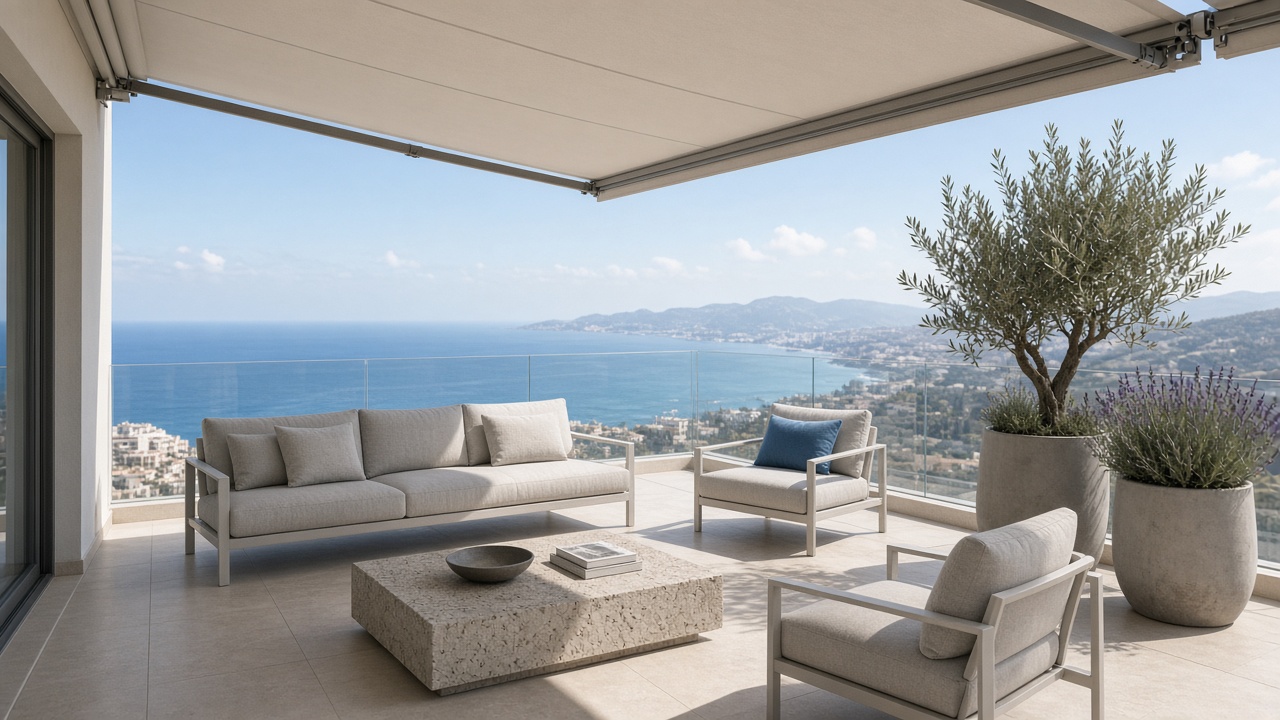
- Fixed shade instead. On exposed terraces I often prefer a fixed solution, such as an awning or a pergola, to a freestanding parasol. Many communities of owners have rules on awnings and anything that changes the façade, so check before ordering.
- Cushions and throws. Ties, non-slip bases, and a storage box for anything soft when you leave.
- Planters. Large planters in heavy materials do double duty as windbreaks and anchors.
Sun, heat and where things go
Placement matters as much as materials. A sofa facing straight into the afternoon sun fades faster and is used less, because nobody wants to sit there at four o'clock in July.
On south- and west-facing terraces I put lounge seating where the building or an awning gives afternoon shade, choose pale frames over black or dark grey, and keep the darkest colours to small pieces that are easy to replace. Cushions that can be turned or swapped between seats fade more evenly. On a north- or east-facing terrace you can be braver with colour.
How I furnish terraces in my packages
Outdoor furniture is now part of every furniture package I offer, designed around the terrace, balcony or garden you actually have rather than a standard set. I plan it from the floor plan and photos, starting with the clear depth from the glass to the balustrade, the direction it faces and how exposed it is.
The style shapes the look. Mediterranean Calm is built on light oak, soft linen and sand tones, which translate outdoors into natural timber and warm neutral cushions. The Coastal Elegance style uses crisp whites and soft stone with blue in the textiles, so a terrace in that style feels lighter and more tailored. The materials underneath follow the same coastal rules in both.
The two package levels are set out on my pricing page: Essentials, from €16,500 + IVA for two bedrooms, is built for holiday rentals and investors who need durable, rental-ready pieces, and Elevated, from €25,500 + IVA for two bedrooms, is for owners who live in the home or want a premium finish, with upgraded upholstery and lighting. Both include delivery, assembly, installation and final styling.
If you would like to see how the process runs from floor plan to finished terrace, the six steps are set out here. If the terrace is part of a wider project, my renovation and painting services cover the work around the furniture, including exterior painting with coastal elastomeric paints. And if you already have outdoor furniture and want a designer's opinion on what to keep, I offer a 2-hour in-home consultation for €279 across the Costa del Sol. My guide to furnishing an apartment in Estepona covers measuring and zoning a terrace in detail.
Winter: store, cover or leave out
Winters here are mild, but they are not dry. AEMET's guide to Málaga airport notes that in autumn especially, the warm sea can feed intense rain. Add winter winds and months when many owners are not here, and the off-season is when neglected outdoor furniture deteriorates.
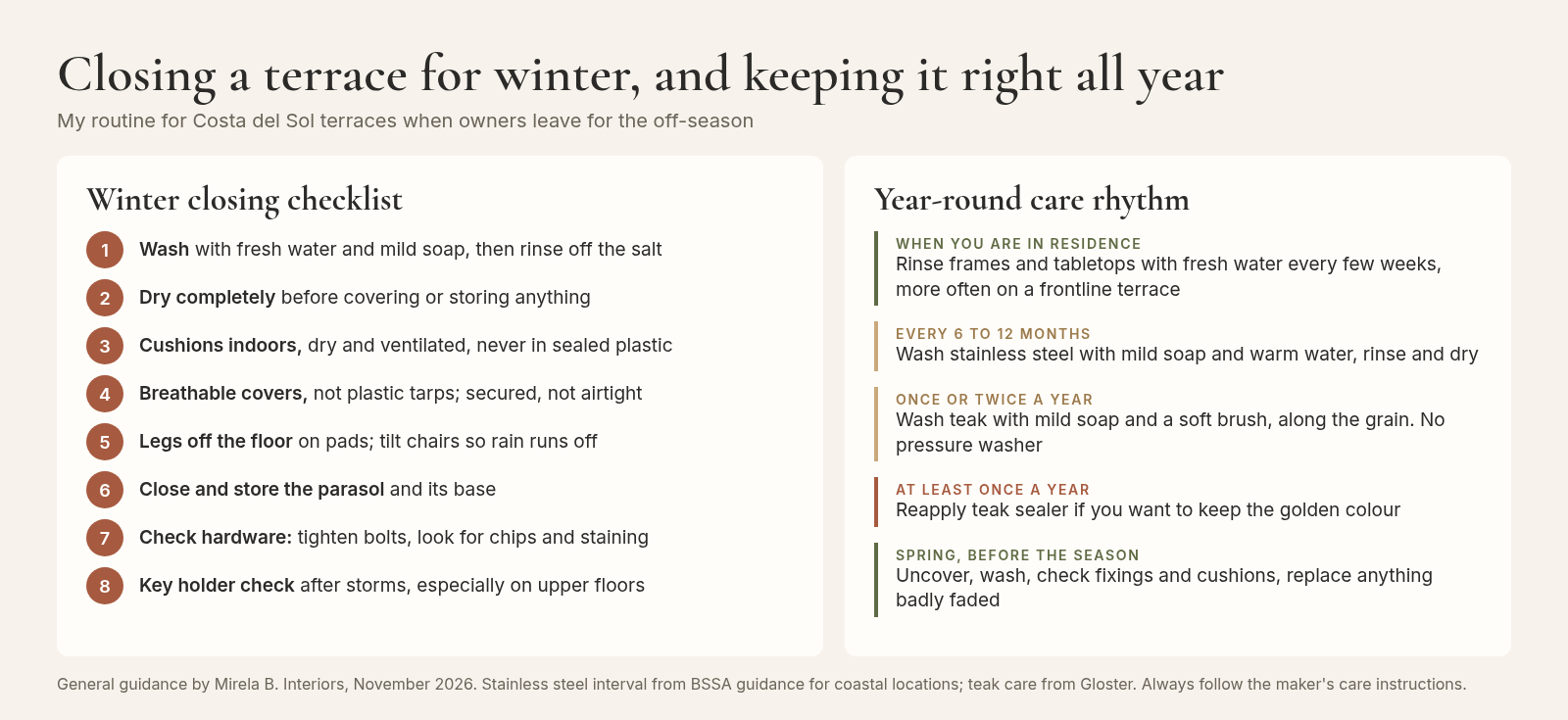
My routine for closing a terrace for the winter:
- Wash everything with fresh water and mild soap, then rinse. Salt left on frames over winter is what causes spring surprises.
- Let it dry completely before covering or storing anything.
- Take cushions indoors. Store them dry, standing on their edge or flat in a ventilated cupboard, never in a sealed plastic bag.
- Use breathable covers made for outdoor furniture, not plastic tarps, which trap condensation. Secure them against wind without sealing them airtight.
- Lift legs off the floor on pads or feet so they are not standing in water, and tilt chairs so rain runs off rather than pooling.
- Close, cover and store the parasol and its base, or take the canopy indoors.
- Check the hardware. Tighten bolts and look for chips in powder coating or early staining on stainless steel.
- Arrange a check after storms with your key holder or property manager, especially on upper floors and exposed terraces.
Teak can stay outside all year, and many owners leave it uncovered. If you store it indoors, Gloster advises against moving it straight from the cold outdoors into a heated room, because sudden changes in temperature and humidity can make the wood move and split.
A simple year-round care rhythm
Most of what keeps terrace furniture looking new is boring and quick.
- When you are in residence: rinse frames and tabletops with fresh water every few weeks, more often on a frontline terrace. Brush cushions off and let them dry before covering.
- Every 6 to 12 months: wash stainless steel with mild soap and warm water, rinse and dry, as the BSSA suggests for coastal locations. Wash teak once or twice a year with mild soap and a soft brush, along the grain.
- If you want to keep teak golden: reapply sealer at least once a year.
- Spring, before the season: uncover, wash, check fixings and cushions, and replace anything that has faded beyond what you can live with.
For a holiday rental, put this on the cleaner's or property manager's checklist.
Frequently asked questions
Can outdoor furniture stay outside all winter on the Costa del Sol?
Frames in teak, good powder-coated aluminium and 316 stainless steel can stay outside if they are washed, dried and raised off the floor. Cushions should come indoors and be stored dry. Breathable covers reduce cleaning but must not trap condensation. Ask a key holder to check the terrace after storms, especially on upper floors.
Is teak or aluminium better for a terrace near the sea?
Both work if the quality is right. Teak is heavy, stays cooler in the sun and weathers to silver grey unless sealed. Aluminium is lighter and comes in any colour, but needs good pretreatment under the powder coating to resist corrosion. On windy terraces I favour teak or heavier aluminium designs.
How do I stop terrace cushions going mouldy?
Use solution-dyed acrylic covers over quick-dry foam with a breathable base, so water drains through rather than sitting inside. Brush off dirt and rinse covers regularly, because mildew grows on dirt rather than on the fabric itself. Always let cushions air dry, and store them dry and ventilated when you leave.
What is the difference between 304 and 316 stainless steel for outdoor furniture?
Grade 316 contains molybdenum, which improves resistance to chlorides such as sea salt. The British Stainless Steel Association recommends 316 for coastal locations and lists 304 as not recommended there. Even 316 needs washing with mild soap and fresh water every 6 to 12 months near the sea to avoid brown tea staining.
How do I stop terrace furniture blowing over in the wind?
Choose heavier and lower pieces, such as teak, ceramic-topped tables and deep lounge seating, and keep light chairs against the wall. Close parasols whenever nobody is using them and give them a heavy base. Use cushion ties or non-slip bases, and put soft items away before you leave the property.
Planning a terrace that lasts
A good terrace on this coast is one you stop thinking about: furniture that stays where you put it, cushions that still look right in the third summer, and a winter routine your key holder can follow in an hour.
If you are furnishing a new home, or your terrace needs rethinking, send me the floor plan, a few photos of the outdoor space and the direction it faces. I will suggest a layout and tell you what it will cost, with the terrace included in the package. You can book a call with me here, message me on WhatsApp at +34 664 276 642, or email mirela@mirelabinteriors.com.